


Posts Header

09 Topography

Addresses mine surveying and measurement using GPS, drones, scanning, and traditional methods for volume and tonnage calculations.

Articles on surveying techniques, photogrammetry, coordinate systems, and volume calculations.

ZVENIA Mining
Corporate at ZVENIA 18/02/2026

Gradeline Control: A Core Duty of the Mine Surveyor in Underground Mining

In underground mining operations worldwide, gradeline establishment and control is a fundamental responsibility of the Mine Surveyor, not just a site marking exercise. As Mine Surveyors, we are responsible for translating approved mine designs, levels, and gradients into the underground environment in accordance with global mining standards and best practice (ICMM principles and internationally recognised QA/QC systems). The gradeline shown here supports key surveying and operational outcomes: 🔹 Accurate development control – Ensuring drives, declines, and crosscuts are excavated to design line and level 🔹 Design compliance and verification – Providing a continuous visual reference for checking conformance and identifying deviations early 🔹 Effective water management – Maintaining correct gradients for drainage and long-term asset integrity 🔹 Safety and risk management – Reducing overbreak, underbreak, rework, and geotechnical exposure 🔹 Operational consistency – Enabling clear communication of survey intent across crews, shifts, and contractors In constrained underground environments, gradelines represent the direct interface between survey control, engineering intent, and excavation execution. Their accuracy directly reflects the quality, accountability, and professionalism of the Mine Survey function. Whether operating in Africa, Australia, or any global mining jurisdiction, precise gradeline control remains a core surveying duty that underpins safe, efficient, and compliant underground mining.

Source: Credit to Obed Owusu-Mensah
Gradeline Control: A Core Duty of the Mine Surveyor in Underground Mining
Like
1
ZVENIA Mining
Corporate at ZVENIA 15/03/2026

5 Common Mistakes Young Surveyors Make on Site

After working on many sites, I keep seeing the same mistakes repeated by young surveyors. Not because they lack talent. Mostly because nobody teaches them the small details that matter. Here are a few common ones: • Not checking control points before starting work • Trusting GNSS accuracy without verifying • Poor tripod setup or leveling • Skipping instrument calibration • Rushing measurements to save time Surveying looks simple from outside. But small mistakes can lead to big problems later in construction. Good surveyors are not just fast. They are careful. They double check. They understand that one wrong coordinate can affect the whole project.

Source: Credit to Ankit Belakud
5 Common Mistakes Young Surveyors Make on Site
Like
2
ZVENIA Mining
Corporate at ZVENIA 27/02/2026

RTK vs PPK

Una comparación breve y práctica sobre dos métodos clave de georreferenciación en levantamientos con VANT. Precisión, flujo de trabajo y en qué casos conviene aplicar cada uno.

Source: Credit to Pamela Constansa Verón

What is Mine Surveying?

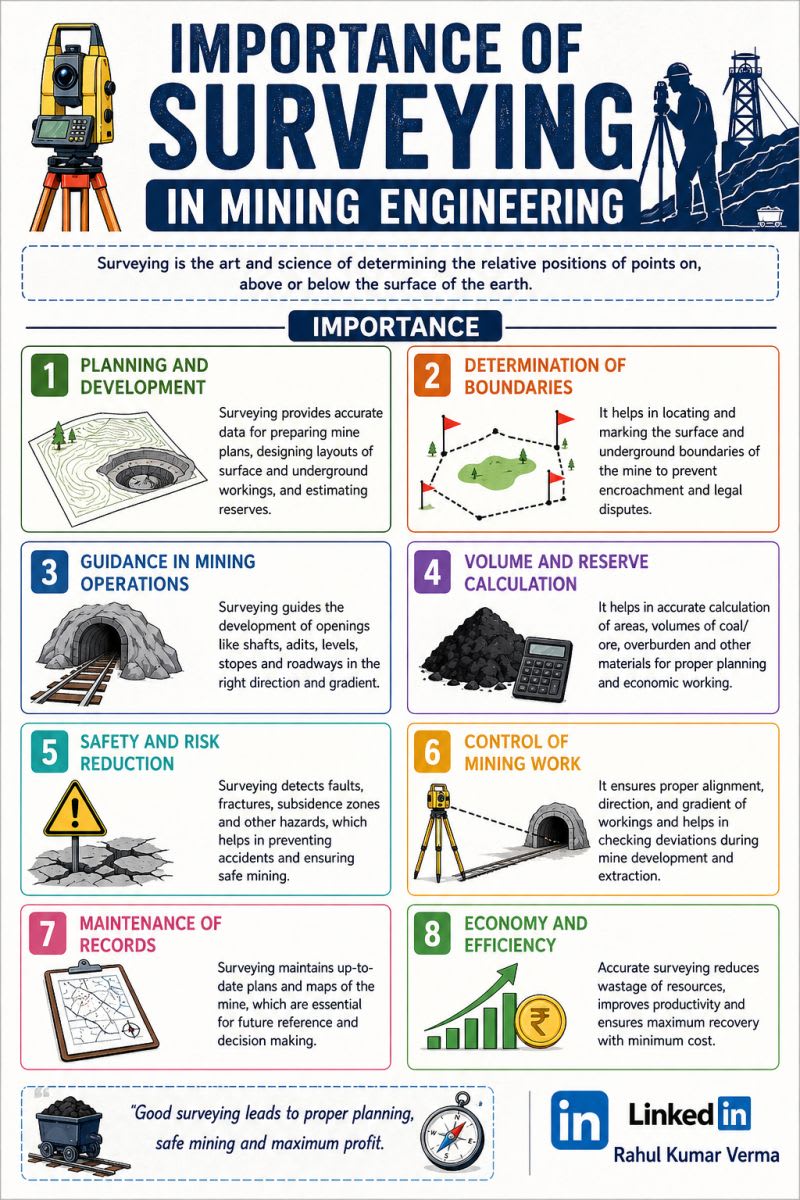
Mine surveying involves the accurate measurement and mapping of mine workings, both on the surface and underground. It is a critical function that ensures safety, supports efficient operations, and ensures legal compliance throughout the mine lifecycle: from exploration and construction to production and final closure/reclamation. 🔍 Key Responsibilities & Functions 1. Exploration & Development · Staking Claims: Precisely demarcating the boundaries of mining leases and claims. · Topographic Mapping: Creating detailed maps of the land surface before any mining begins. · Drill Hole Location: Accurately positioning and surveying drill holes for resource estimation. 2. Operational & Production Phase · Volume Calculation (Volumetrics): Measuring stockpiles of ore and waste material to calculate volumes and tonnages. This is essential for production accounting and reconciliation. · Stakeout and Setout: Marking the location for new infrastructure, roads, ramps, and drill patterns on the ground. · Mine Planning Integration: Providing accurate data for the Mine Planning department to design pits, underground stopes, and waste dumps. 3. Safety & Monitoring · Stability Monitoring: Using specialized equipment to monitor highwalls, pit slopes, tailings dams workings for any movement or deformation that could lead to a collapse. · Avoiding Breaches: Ensuring mining does not accidentally breach into adjacent properties, old workings, or hazardous zones. · Volume of Blasts: Surveying blast holes and calculating the volume of rock to be blasted for precise explosive charging. 🛠️ Technologies Used in Mine Surveying Modern mine surveyors use a suite of advanced technologies: -GNSS (GPS) Provides real-time, highly accurate positioning for surface surveying, vehicle tracking, and machine guidance. -3D Laser Scanning (LiDAR) Creates millions of data points to generate a highly detailed "point cloud" of a pit, stockpile. Ideal for volume calculations and monitoring complex geometries. -Drones (UAVs) Equipped with cameras or LiDAR, drones can quickly and safely survey large or inaccessible areas like open pits, tailings dams, and stockpiles, generating orthomosaics and digital terrain models. -GIS (Geographic Info Systems) The platform for managing, analyzing, and visualizing all spatial data related to the mine site. -Survey & Monitoring Sensors Robotic total stations and radar systems for continuous, automated monitoring of critical slopes and structures. 📊 Deliverables of a Mine Surveyor The work of a mine surveyor results in critical documents and data: · Plans and Maps: Surface plan. · Volume Reports: Monthly reports on ore mined, waste moved, and stockpile inventories. · Digital Terrain Models (DTMs) & 3D Models: Digital representations of the mine's topography and geology. · Geodetic Control Network: A network of precisely located.

Source: Credit to Sié Abdoul Kader KONATE
What is Mine Surveying?
Mohamed Coulibaly
Mining Engineer 13/10/2025

Conformité entre Plan et Miné

La conformité au plan s'est avérée être l'un des indicateurs de performance clés (KPI) les plus importants dans le secteur minier. La conformité au plan consiste à suivre et à évaluer la corrélation entre ce qui est extrait de manière opérationnelle sur le terrain (données réelles) et ce qui était prévu (données planifiées) pour être extrait au cours d'une période spécifique. Ceci est effectué principalement pour rapporter spatialement et quantitativement, le matériel qui était Planifié et Miné, Planifié et Non Miné ainsi que Miné et Non Planifié. Le succès d'une mine dépend dans une certaine mesure des éléments clés suivants : la qualité et l'intégration des plans en place (du long au court terme) et de l'exécution des plans définis. Il est essentiel de structurer les plans d'exploitation et les activités à plus court terme de manière à ce que la mine soit évidemment en mesure d'atteindre les objectifs opérationnels et financiers. Il est encore plus important de s'assurer que les plans et activités opérationnels à court terme sont exécutés d'une manière qui ne compromet pas la capacité de la mine à respecter le plan à long terme défini.

Like
1
ZVENIA Mining
Corporate at ZVENIA 03/07/2025

Tratado de Topografía (300 pages)

Lectura esencial para quienes miden, proyectan y construyen el territorio Me permito recomendar una obra que ha marcado generaciones de ingenieros topógrafos, constructores y proyectistas: el “Tratado de Topografía” de Raymond E. Davis, acompañado por Francis S. Foote y Joe W. Kelly. Más que un simple libro, este compendio es un pilar académico y técnico que atraviesa con rigor los fundamentos, métodos modernos e históricos, instrumentos y aplicaciones de la topografía clásica y aplicada. 📚 En su quinta edición, cuidadosamente traducida por el Dr. José María Mantero, este tratado no solo sirve como texto para estudiantes, sino como una herramienta de consulta permanente para profesionales. Su enfoque exhaustivo abarca desde el uso del teodolito y la cinta hasta los levantamientos fotogramétricos, caminos, minas, obras civiles y medición de caudales. Con ejemplos, problemas de campo, fundamentos astronómicos y prácticas de gabinete, logra un equilibrio entre teoría y experiencia. 🌍 Como docente y profesional, valoro especialmente su énfasis en la precisión, trazabilidad y responsabilidad del topógrafo frente a la sociedad. Es un recordatorio de que cada plano, cada curva de nivel y cada punto georreferenciado tienen impacto en las decisiones territoriales, ambientales y técnicas. 📐 Si trabajas en diseño de infraestructura, catastros, obras civiles, hidráulicas o minería, este tratado sigue siendo una fuente confiable y profunda para revisar conceptos, resolver problemas y formar nuevas generaciones con base sólida. 🔗 La topografía no ha pasado de moda: se ha modernizado, se ha digitalizado, pero sigue siendo el arte y la ciencia de conocer la tierra con exactitud. Authors: R A Y M O N D E. D A V IS F R A N C I S S . F O O T E y J O E W . K E L L Y Profesores de Ingeniería en la Universidad de California Versión española de JO SE MARIA MANTERO Dr. Ingeniero Geógrafo

Source: Credit to Luis Antonio Leiva Olea
Samuel OKONKWO
Mine surveyor at Sayech mineral and mining 09/06/2025

The Incredible Impact of Drone Data in Nigeria’s Mining Industry

In today’s fast-evolving mining sector, drone technology is doing more than capturing beautiful aerial shots — it's transforming how we plan, operate, and monitor mining sites across Nigeria. As a mine surveyor deeply involved in field operations, I've witnessed firsthand how high-resolution drone data is driving a new era of precision, safety, and cost-efficiency. 🔍 Here’s how drones are making a difference in Nigerian mining: ✅ Rapid Topographic Surveys: What used to take weeks can now be done in hours — reducing manpower, improving accuracy, and saving cost. ✅ Real-time Monitoring: Frequent site updates via drone data provide mine managers with actionable insights on progress, safety concerns, and environmental impact. ✅ Volume Calculations: Stockpile and overburden volumes are now measured with centimetre-level accuracy, aiding better decision-making and inventory control. ✅ Environmental Compliance: Drones assist in monitoring land disturbance, ensuring mining operations adhere to Nigeria’s environmental regulations. ✅ Improved Safety: High-risk zones can be surveyed remotely, reducing human exposure to hazardous areas. As Nigeria continues to attract both local and international investors, integrating drone data into mining operations is no longer a luxury — it’s a necessity for sustainable, data-driven growth in the extractive sector. At Sayech Mineral and Mining Limited, we’re committed to harnessing these technologies to reshape the future of mining in Nigeria. 📡 Interested in exploring drone solutions for your mining site? Let’s connect and discuss how drone intelligence can power your operations.

The Incredible Impact of Drone Data in Nigeria’s Mining Industry
ZVENIA Mining
Corporate at ZVENIA 16/05/2025

Geometric Equations Used by a Total Station

A Total Station is a surveying instrument that combines an electronic theodolite (for measuring horizontal and vertical angles) and an Electronic Distance Measurement (EDM) device. It measures angles and distances and converts them into coordinates using geometric equations. 1. Conversion from Polar to Cartesian Coordinates (XYZ) When the instrument measures: Horizontal angle (θ), Vertical angle or elevation angle (α), Slope distance (S), It calculates the coordinates of the unknown point using the following equations: X = X₀ + S × cos(α) × sin(θ) Y = Y₀ + S × cos(α) × cos(θ) Z = Z₀ + S × sin(α) Where: (X₀, Y₀, Z₀) are the coordinates of the instrument (station), θ is the horizontal angle (from a reference direction), α is the vertical angle (from the horizontal plane), S is the slope distance to the point. 2. Horizontal Distance and Vertical Difference Horizontal distance (H) = S × cos(α) Vertical difference (ΔZ) = S × sin(α) 3. Angle Calculation Using the Cosine Rule To find angles in a triangle between three points: cos(θ) = (a² + b² - c²) / (2ab) 4. 3D Distance Between Two Points To calculate the spatial distance between two points: D = √[(X₂ - X₁)² + (Y₂ - Y₁)² + (Z₂ - Z₁)²]

Source: Credit to Ahmed mohamed
Geometric Equations Used by a Total Station
ZVENIA Mining
Corporate at ZVENIA 09/05/2025

Diferencia entre usar y no usar puntos de control en Fotogrametría

1. Con Puntos de Control en Tierra (GCPs). Precisión: Alta precisión absoluta (centimétrica). Uso de GPS RTK/PPK: Complementa o refuerza la precisión. Aplicaciones: Topografía, Catastros, Obras Civiles, Ingeniería. Ventajas: Mayor confianza en la georreferenciación y mejores resultados. Desventajas: Requiere más tiempo en campo y equipo GNSS. 2. Sin Puntos de control en Tierra (Solo GPS del dron) Precisión: Relativa aceptable, pero baja precisión absoluta. Uso del GPS del dron: Dependencia total del GPS embarcado, es decir sin correcciones. Aplicaciones: Agricultura, monitoreo visual, inspecciones rápidas. Ventajas: Más rápido menos equipamiento en campo. Desventajas: Error absoluto puede ser de varios metros depende del GPS del dron. ¿ Por qué es importante esta diferencia? * Proyectos de ingeniería necesitan precisión absoluta para posicionar estructuras con exactitud. * En monitoreo periódico si no hay GPS, los modelos pueden no coincidir espacialmente entre campañas. * El uso del GCPs reduce el error en el procesamiento fotogramétrico (RMS), especialmente en zonas con más señal GNSS.

Source: Credit to Cristián Cerón Charme
Diferencia entre usar y no usar puntos de control en Fotogrametría
ZVENIA Mining
Corporate at ZVENIA 01/05/2025

GCP vs RTK vs PPK

Navigating Precision in Drone Mapping 🌐✈️ Embarking on a mapping mission? 🗺️ Let's explore the pros and cons of three pivotal technologies: Ground Control Points (GCP), Real-Time Kinematics (RTK), and Post-Processed Kinematics (PPK). 🛰️💡 Ground Control Points (GCP): Pros: 1-Absolute Accuracy: GCPs provide a benchmark for absolute accuracy, ensuring reliable georeferencing. 2-Versatility: Suitable for various mapping applications and projects of different scales. 3-Cost-Effective: Initial setup costs might be lower compared to some RTK/PPK solutions. Cons: 1-Time-Consuming: Manual placement and surveying of GCPs can be time-intensive. 2-Logistical Challenges: Accessibility to GCP locations may pose logistical challenges in remote or rugged terrains. 3-Dependency on Surveyor Expertise: Accuracy heavily depends on the surveyor's expertise in placing GCPs. Real-Time Kinematics (RTK): Pros: 1-Real-Time Corrections: Provides real-time, centimeter-level accuracy during drone flights. 2-Reduced Ground Control Needs: Decreases the dependency on a dense network of GCPs. 3-Time Efficiency: Accelerates data collection with instant corrections. Cons: 1-Limited Range: RTK requires a continuous connection to a base station, limiting operational range. 2-Signal Interference: Can be susceptible to signal interruptions in urban canyons or areas with dense vegetation. 3-Cost: RTK-enabled equipment tends to be more expensive than traditional setups. Post-Processed Kinematics (PPK): Pros: 1-Flexibility: Eliminates the need for real-time communication, allowing more flexibility in mission planning. 2-Centimeter-Level Accuracy: Achieves high accuracy through post-processing, comparable to RTK. 3-Reduced Dependency on GCPs: Minimizes the necessity for an extensive GCP network. Cons: 1-Post-Processing Time: Requires additional time for post-processing, impacting real-time decision-making. 2-Equipment Cost: PPK-enabled drones and software may have a higher upfront cost. 3-Learning Curve: Mastery of post-processing workflows may be needed for optimal results. Image credit: ageagle.com You can explore more about world wide RTK services at: RTKdata.com In the dynamic landscape of drone mapping, each technology has its role. Choose wisely based on project requirements, terrain, and budget. Let's elevate our mapping game! 🌐✨

Source: Credit to S. Hassan Alavi
GCP vs RTK vs PPK

Preview of ZVENIA Mining

Sign up to get unlimited content. No credit card needed.

Sign Up Free