
ZVENIA Mining is the human layer of mining: where professional expertise stops being invisible and starts working for you. We organize verified professionals across 25 technical domains in 76 countries, making them findable by specialty. Whether you need the right expert for a project or you want your own expertise to have a real address in the industry, this is where it happens. Register your expertise once. The system compounds it.
Estimados Amigos y Colegas a través de la presente es grato saludarlos así mismo quiero compartir con ustedes un trabajo desarrollado en el Curso de Fundamentos en Economía de Minerales III-2024, denominado: Errors and Uncertainty in Mineral Resource and Ore Reserve Estimation: The Importance of Getting it Right, se trata de un análisis sobre cómo gestionar los errores e incertidumbres identificados en el proceso de estimación de recursos y reservas de mineral según las regulaciones internacionales.
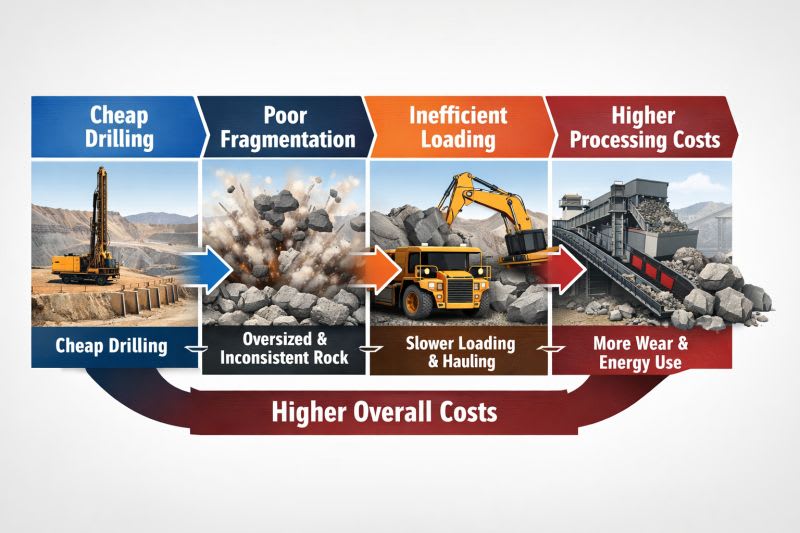
Consequent to a previous article, we have been asked to discuss briefly the financial implications of poor drilling.
When we talk about drill and blast, the conversation usually leans towards explosives and their application, while the drilling component gets far less attention.
Many operations still track drilling the way they always have: cost per metre drilled.
It’s neat. It’s familiar, yet it’s dangerously incomplete.
Drilling doesn’t exist in isolation. Every metre drilled sets the conditions for blast performance, downstream productivity, and ultimately profitability.
When drilling is optimised solely to reduce the drill contractor’s invoice, costs are often pushed—quietly but significantly—into every stage that follows.
That’s why Total Drilling Cost matters far more than drill cost alone.
What Is TDC (Really)?
Total drilling cost is not just:
Drill contractor rates
Consumables
Maintenance
Fuel and labour
It also includes the consequences of drilling quality:
Hole deviation and collar accuracy
Burden and spacing variability
Sub-drill consistency
Redrilling
Misfires and blast inefficiencies
Poor fragmentation impacting loading, hauling,crushing
Increased dilution, losses, or downstream bottlenecks
A cheap metre drilled badly is one of the most expensive metres you’ll ever mine.
The False Economy of “Cheap Drilling”
We've seen this pattern repeatedly:
Drill rates are pushed down
Penetration rate becomes the primary KPI
QA/QC is reduced
Operators are incentivised on metres, not quality
On paper, drilling cost improves.
In reality:
Blast performance becomes inconsistent
Powder factor increases to compensate
Dig rates slow
Crusher throughput drops
Maintenance costs rise
Reconciliation gaps widen
The operation spends far more trying to fix the blast than it saved on drilling.
Shifting the Conversation: From Cost to Value
High-performing operations look at drilling differently:
Cost per effective hole, not cost per metre
Accuracy compliance, not production metres
Drill-to-blast alignment, not isolated KPIs
System performance, not departmental optimisation
They understand that drilling is a precision activity, not a volume race.
What to Measure Instead
If you want to understand your true drilling cost, ask:
How much rework are we carrying due to poor hole placement?
What is the variance between planned and achieved burden?
How often do blast designs require modification to compensate for drilling?
What is the downstream cost of poor fragmentation?
Are drill KPIs aligned with blast outcomes—or working against them?
These answers rarely sit in one department.
Final Thought
Drilling is the first act in value creation.
Get it right, and everything downstream becomes easier.
Get it wrong, and no amount of blasting “optimisation” will save you.
If you’re still judging drilling purely on cost per metre, you’re likely paying far more than you think.
Mining executives are too distracted to fix operations.

Technology is not the answer.

Surprising to hear from someone who markets mining technology, I know. But hear me out.
Mining tech conferences are packed these days. Vendors pitch AI dashboards, autonomous trucks, and predictive-maintenance platforms. Boardrooms nod along, eager not to fall behind. Yet when Bain* recently asked executives from miners worth a combined $300bn to rank the factors most critical to improving site operations, technology came dead last.
What topped the list was considerably less photogenic. Buy-in from the front line and management came first, followed by a strong understanding of what actually creates value and, in third place, stable leadership.
The executives were saying that without the human scaffolding, even the cleverest tools amount to expensive furniture.
Technology works just fine. The software does what it promises.
The problem is rarely the tool.
The problem is the system underneath it.
And if that system is flawed, if decision rights are murky, if leadership turns over every eighteen months, if nobody on the front line was consulted before the rollout, then no amount of technology will fix it. You are just automating a broken process. You have to start from the beginning: people.
The more conversations I have with stakeholders across this industry, the clearer a pattern becomes.
There are two ways to bring innovation into mining.
The first, which most choose, is to adapt to the existing audience.
Sell to them the way they are used to buying. This is why mining tech startups begin with a consulting model before attempting to shift towards subscription or platform plays. It is pragmatic. It gets you in the door. But it also means you end up reinforcing the very system you set out to improve.
The second way is to try to shift the industry's thinking altogether.
This is harder, slower, and impossible for any single company or person to pull off alone. It requires a collective effort from operators, vendors, investors, and the growing number of voices in this sector who see that the old way of doing things is running out of road.
The pressure to produce more from less is not going away, and adapting to an outdated operating model will not meet it.
If you are a tech vendor, your leverage is limited. You build the best product you can and hope the buyer is ready for it. But there are plenty of people across this industry with platforms, experience, and credibility who could help change the narrative.
Mining's greatest untapped resource remains the one that has always been there: people who know the operation, who stay long enough to see changes through, and who are trusted enough to be told the truth when things go wrong. The industry would do well to invest in them with the same enthusiasm it reserves for the latest AI.
Whether enough of those voices choose to speak up is another question.
Every mine operates within a defined timeframe known as the Life of Mine (LoM). From the first blast to the final tonne and eventual closure, LoM planning ensures that mining is carried out efficiently, safely, and profitably over the entire lifespan of the operation.
This week, we explore what Life of Mine means and why it is one of the most important concepts in mining engineering.
⏳ What Is Life of Mine (LoM)?
Life of Mine refers to the total duration over which a mineral deposit can be economically extracted, based on available reserves, production rates, and economic conditions.
LoM is not just a number of years — it is a strategic plan.
🧩 Key Components of Life of Mine Planning
1. Resource & Reserve Base
Defines how much material is available for extraction.
2. Production Rate
Determines how fast the ore is mined and processed.
3. Mining & Processing Strategy
Choice of mining method, equipment, and processing route.
4. Economic Assumptions
Commodity prices, costs, and cut-off grade.
5. Closure & Rehabilitation Planning
End-of-mine considerations integrated from the start.
⚙️ Why Life of Mine Matters
📈 Guides long-term investment decisions
💰 Influences cash flow and project valuation
🛠️ Aligns short-term plans with long-term goals
🌱 Integrates sustainability and closure from day one
📊 Helps manage risk and uncertainty over time
A well-defined Life of Mine is the backbone of responsible and profitable mining.
💬 Do you think Life of Mine estimates should be conservative or optimistic? Share your thoughts.
If this added value, like, comment, follow, and repost to support mining education.
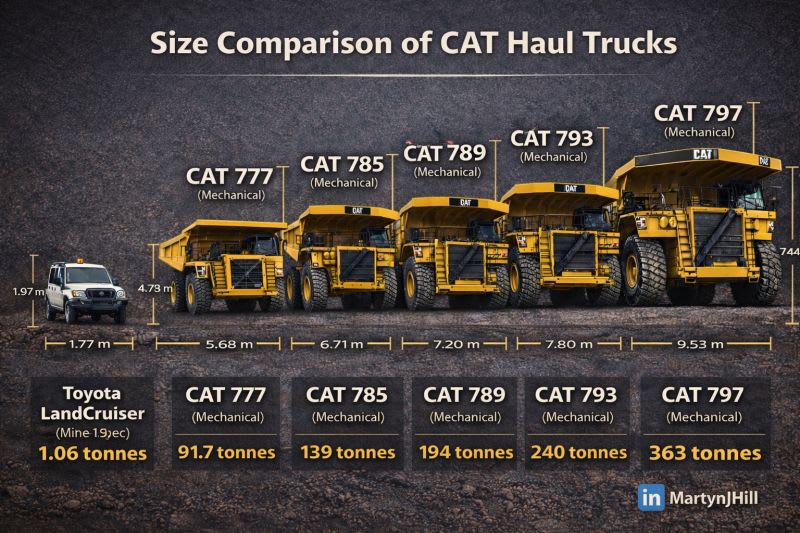
This side-by-side comparison shows just how quickly mining equipment scales, and why lumping machines together misses the reality of modern operations.
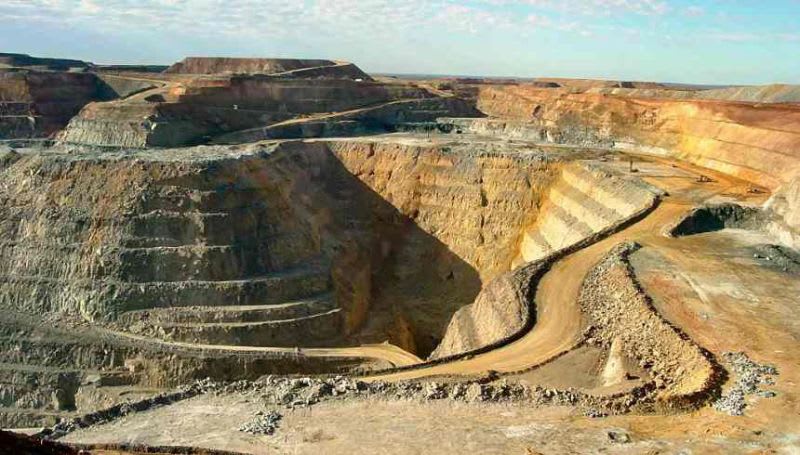
A mine-spec Toyota LandCruiser is designed for mobility, inspections, and supervision. It weighs just over a tonne and operates in a low-consequence environment.
Step into a CAT 777 and you are already dealing with a 90-plus tonne machine where braking distance, payload discipline, and ground conditions matter. Move up through the 785, 789 and 793 classes and each jump brings exponential increases in size, energy, tyre loads, maintenance complexity, and safety exposure.
By the time you reach the ultra-class CAT 797, you are in a completely different operating category. At more than 360 tonnes, this truck does not simply service a mine, it defines it. Haul roads, pit geometry, maintenance workshops, fuel systems, and training frameworks are all engineered around equipment of this scale.
This is why ultra-class fleets are typically found at tier-one operations run by miners such as BHP, Rio Tinto, Fortescue, Newmont and Vale. These machines only make sense where ore bodies are large, mine lives are long, and operational discipline is non-negotiable.
The takeaway is simple.
As equipment scales, so do the operating environments around it. Light vehicles, mid-class haul trucks and ultra-class fleets sit on a continuum of size, consequence and complexity, each requiring different levels of planning, support and experience.
Scale does not change the fundamentals of mining, but it significantly changes how they must be managed.
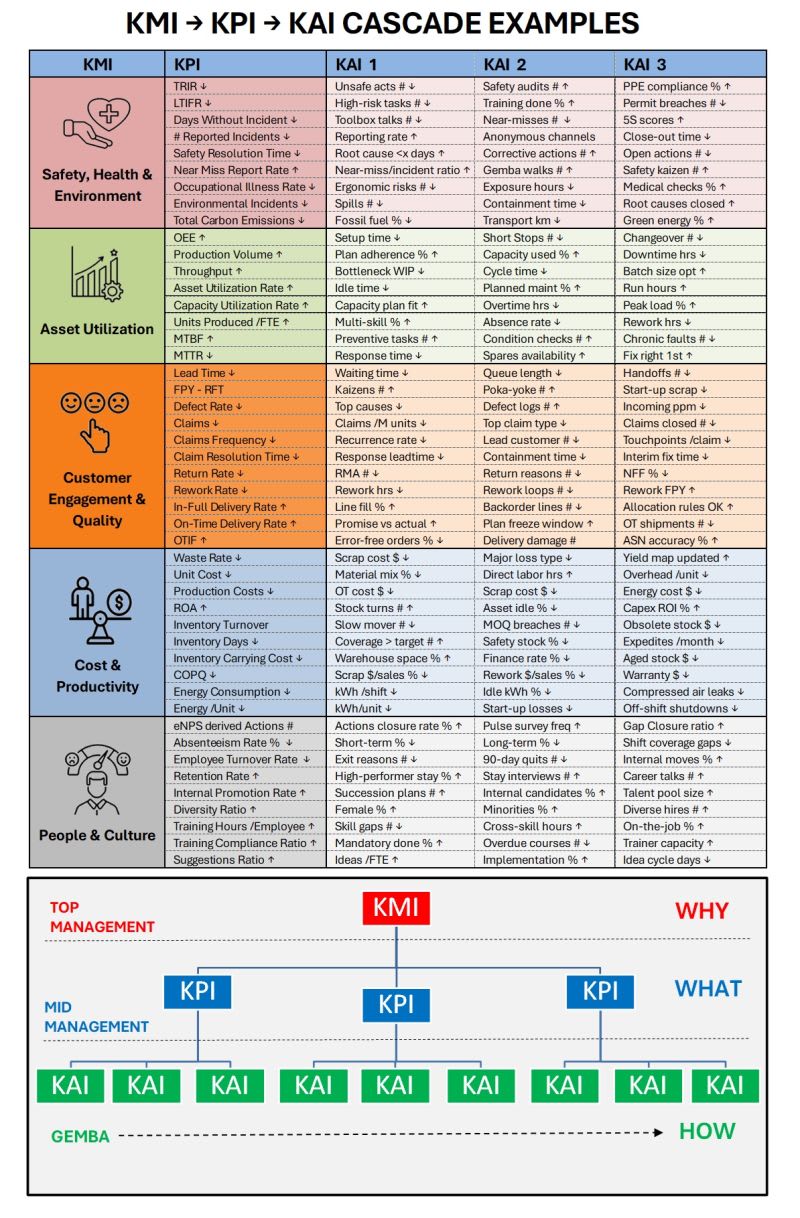
From Hoshin to Gemba: Japanese KMI → KPI → KAI in Action
In many companies, performance management quickly becomes a jungle of disconnected numbers. Japanese management philosophy offers a very simple and powerful cascade that solves this: KMI → KPI → KAI
✅ KMI (Key Management Indicator):
The “WHY”
KMIs are the few strategic indicators owned by top management. They describe what really matters for business over the term such as:
🎯 Safety, Health & Environment
🎯 Customer Engagement & Quality
🎯 People & Culture
🎯 Asset Utilization
🎯 Cost & Profitability
Think of KMIs as the North Stars on your dashboard : there should be only a few
✅ KPI (Key Performance Indicator):
The “WHAT”
KPIs translate each KMI into measurable process metric. One KMI is usually supported by several KPIs, but total set should still be lean (10 max for site). Examples :
Safety, Health & Environment:
-TRIR, Days Without Incident, Emissions
Asset Utilization:
- OEE, Throughput, Capacity Utilization
Customer Engagement & Quality:
- RFT, Claims, OTIF
Cost & Productivity :
- Unit Cost, Inventory Turnover, COPQ, Energy Consumption
People & Culture :
- eNPS, Absenteeism, Turnover, Suggestions
✅ KAI (Key Activity Indicator):
The “HOW”
KAI's are specific actions at shop‑floor level that move the KPIs. They are concrete and small enough to be owned by a team. Examples :
To improve OEE; KAIs could be:
- Setup time ↓
- # of Breakdowns ↓
- MTBF ↑
- Short stops # ↓
To improve TRIR, KAIs could be:
- Observations # ↑
- Safety audits # ↑
- PPE compliance % ↑
To improve Suggestions, KAIs could be:
- Ideas/FTE ↑
- Implementation % ↑
- Idea cycle days ↓
The KAI key is ‘Activity’, not a result.
Why KMI → KPI → KAI Cascade
1️⃣ Aligns strategy to Gemba
Everyone can see how today’s kaizens, suggestions, or project contributes all the way up to Safety, Customer, Cost, or People objectives
2️⃣ Clarifies target setting
You start with few KMIs, translate them into focused KPIs, then define KAIs, teams can influence every day
3️⃣ Enables performance management, not just reporting
Reviews can follow simple logic: KMI trend ↓ → which KPI is off? → which KAI needs to improve/change?
4️⃣ Drives Continuous Improvement
KAI's become natural funnel for Kaizens: If KPI is red, teams propose and track more Kaizens until it turns green.
How to implement
✅ Start by agreeing on 4–5 KMIs that truly define success for your site
✅ Limit yourself to max 10 KPIs, clearly owned, each mapped to one KMI
✅ For each KPI, define 2–3 KAIs, specific activities you want teams to execute
✅ Review regularly KMI → KPI → KAI on the same page, as in visual, so everyone sees connection
When you get this right, you create a clear line of sight:
KAI improves KPI → KPI improves KMI → Every team, Every shift, Every individual, Every improvement contributes directly to the company’s success.
*Plase follow + like + leave a comment (NOT an email address) & message me within LinkedIn for file
Geotechnical focus:
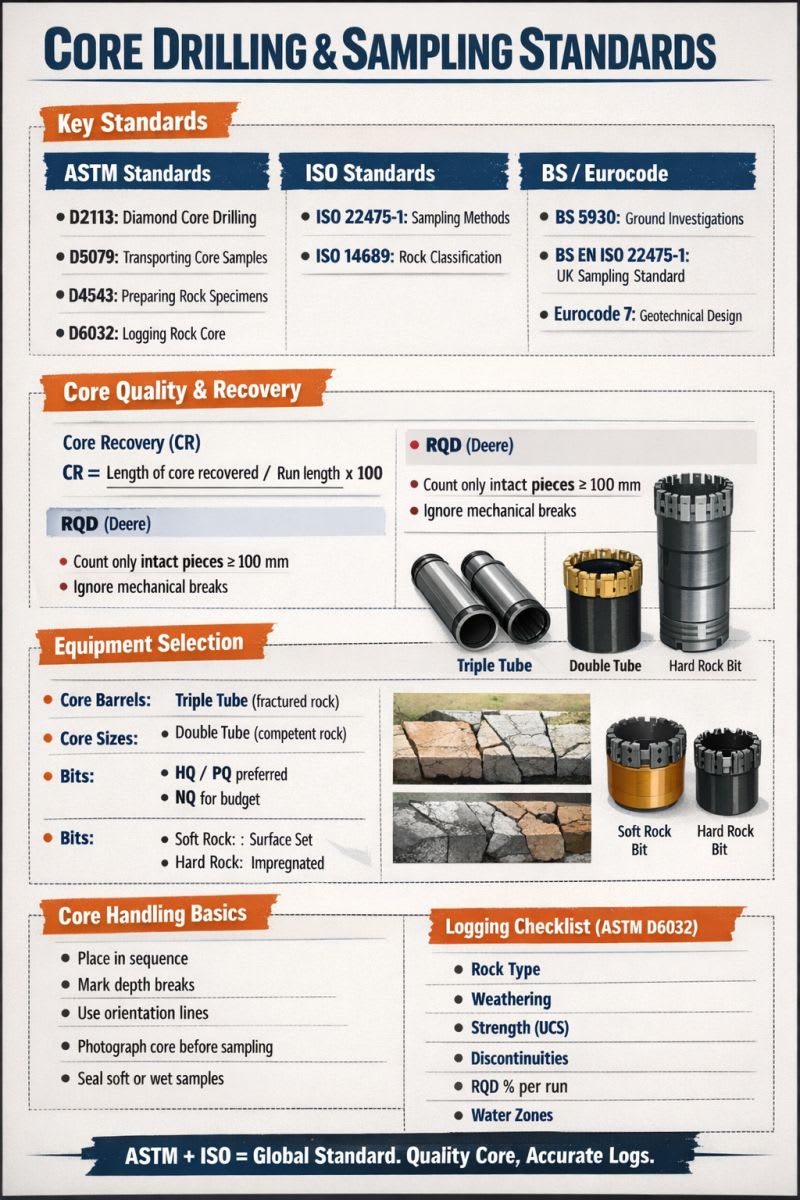
Core drilling and sampling standards are about controlling damage, not just drilling depth: correct core barrel and bit selection (HQ/NQ/T2), low-disturbance drilling parameters, full core recovery, proper orientation, and disciplined handling and boxing. Poor practice shows up immediately as low recovery, broken core, and unreliable RQD.
Mineral exploration focus:
In mineral exploration, core drilling standards aim to preserve geology and structure: appropriate barrel size, stable drilling parameters, accurate core orientation, and strict core handling and logging. Recovery quality directly affects structural interpretation, grade control, and confidence in resource models.
Reviewing mining projects from discovery through to operations, there’s one issue that comes up time and time again: resource classification.
Teams spend countless hours on estimation methods and geological interpretation, only to fall short when it comes to correctly classifying the resource.
Why does it happen?
Optimism bias (often driven by board or funding expectations)
Time pressure at the end of a study
Inexperience with classification standards
Or simply underestimating how critical classification really is
As an external reviewer, here are a few practical principles that consistently separate robust resource models from risky ones:
🔹 Let drill spacing lead the classification
Be strict. If there are spacing gaps, classify them accordingly. No “spotted dogs”.
🔹 Avoid circles around drill holes
Resources aren’t radial. Use orebody knowledge and geological controls to define realistic shapes.
🔹 Data integrity matters
QAQC results, core recovery, and missing samples must be reflected in the classification. Confidence in tonnes starts with confidence in data.
🔹 Respect the limits of your estimation parameters
Search radii, variography, and interpolation choices should cap — not inflate — classification confidence.
🔹 Classify waste properly
If the drill spacing supports a measured ore classification, the same logic applies to internal waste.
Mining companies want to know where measured waste is — ironically, we mine far more waste than ore.
Resource classification isn’t a tick-box exercise. It’s a risk statement, and decision-makers rely on it more than we often acknowledge.
Get it right early, and everything downstream — mine design, scheduling, economics — becomes stronger.
Happy to discuss or hear how others approach this challenge in their projects.
A short post to remind mine planning engineers that grade is just a proxy for value. You need to prove to yourself that it is a good proxy to use.
Years ago, I used to present a value creation and #CutOffGrade seminar. I would start the seminar with the following three questions as a thinking exercise:
Q1: Consider two blocks of ore (everything else being equal), which block has higher value:
(a) 100 tonnes @ 2.0% Cu.
(b) 100 tonnes @ 2.5% Cu.
The obvious answer would be (b), as it contains 2.5 tonnes of copper, versus (a) with 2.0 tonnes of contained copper
Q2: Consider the same two blocks of ore, but now with recovery information (and again everything else being equal), which block has higher value::
(a) 100 tonnes @ 2.0% Cu - with 80% recovery.
(b) 100 tonnes @ 2.5% Cu – with 85% recovery.
Again, the obvious answer would be (b), as it has 2.1 tonnes of recovered copper versus (a) with 1.6 tonnes of recovered copper.
Q3: Now consider the same two blocks of ore, with recovery information and throughput information (and again everything else being equal), which block has higher value:
(a) 100 tonnes @ 2.0% Cu - with 80% recovery, and SAG mill throughput of 100 tph (so soft ore, and/ore well fragmented).
(b) 100 tonnes @ 2.5% Cu – with 85% recovery, and SAG mill throughput of 70 tph (so hard ore, and/or poorly fragmented).
Now, the answer flips to (a), as (a) has a recovered copper per hour ‘value’ of 1.6 tonnes Cu per hour, and (b) has a ‘value’ of 1.49 tonnes Cu per hour.
So, in this third situation, the lower grade, lower recovery ore provides 7% greater ‘value’ in time – and it is what we produce in time that ultimately determines the value (NPV is after-all a measure of ‘$s in time’).
This leads to the ‘cash flow grade’ concept, quite well described by Dr Brett King in a paper he write back in 1999. (I loved this paper when I first read it, as I was ~90% there myself - and felt frustration that Brett had written it first!) The concept also leads to the necessary identification of system bottlenecks that need to be exploited (#TheoryOfConstraints) to increase the ‘value flow’.
These concepts are effectively what Gerald Whittle has effectively based his business on: the cash flow grade concept – combined with TOC – and using software to solve complex systems that can result.
So – grade is just a proxy for value. Sometimes it can be a good proxy. Other times it can be a poor proxy.
I have only ever once seen a feasibility study use a cash flow grade for the mine schedule. And I will be first to acknowledge it is not an easy thing to use. It can’t be directly measured like a grade. It must be calculated from multiple factors – of which grade is just one factor. And we usually often don’t have reliable models for those other relevant factors.
My advice: do as much economic value modelling of your ore value as you can, and find some approach to cut-off value that is practical and makes sense, AND captures some of that time value.
References
King, B. 1999, “Cash Flow Grades - Scheduling Rocks with Different Throughput Characteristics”, Proc. Conf. Optimising with Whittle, Perth 1999.
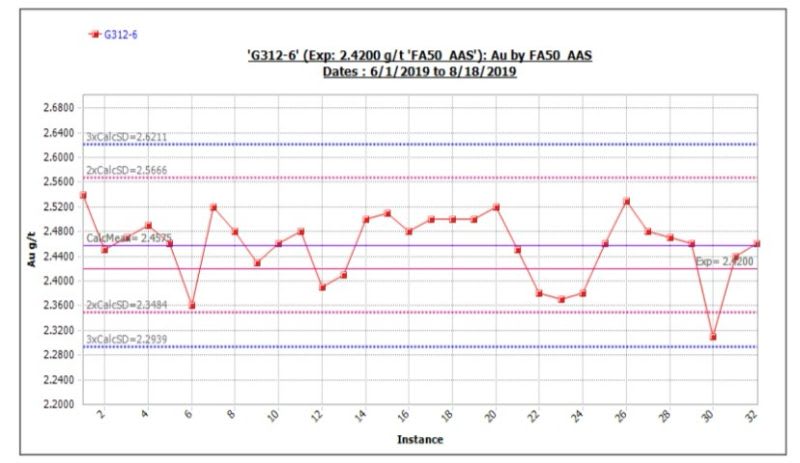
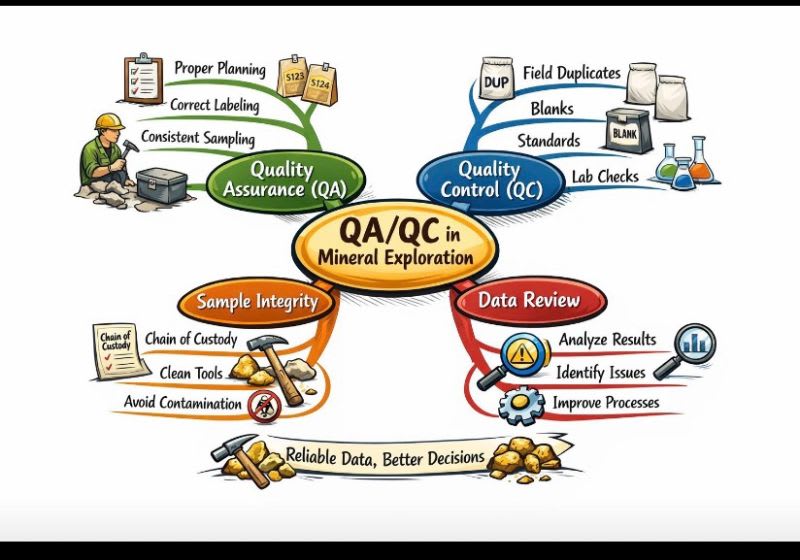
Dans les opérations minières, la qualité des données est aussi importante que la production elle-même. En grade control, le QAQC (Quality Assurance & Quality Control) joue un rôle essentiel pour garantir la fiabilité des teneurs et sécuriser la prise de décision.
🔎 Pourquoi le QAQC est indispensable ?
• Assurer la précision des résultats analytiques
• Détecter rapidement les erreurs d’échantillonnage ou de laboratoire
• Réduire les risques financiers liés aux mauvaises estimations de teneur
• Renforcer la confiance entre terrain, laboratoire et géologie
🧪 Les outils clés du QAQC :
✔️ Blanks – pour vérifier la contamination
✔️ Standards/CRM – pour contrôler la précision des analyses
✔️ Duplicates – pour évaluer la reproductibilité
✔️ Suivi des tendances et validation des lots avant utilisation
Un programme QAQC bien appliqué permet de transformer des données brutes en informations fiables, essentielles pour optimiser l’exploitation et réduire les incertitudes.
En mine, de bonnes décisions commencent toujours par de bonnes données.
Source: Credit to MLEHE ZRANLEU JACOB GBEADA
1 / 2
2 / 2
2
autorenew
Loading more posts...
EVENTS
Here is the list of events by ZVENIA Mining.
Discover upcoming conferences, seminars, and webinars.