

Posts Header

18 Performance levels

Focuses on performance frameworks, maturity models, and operational excellence.

Content on KPIs, performance levels, master plans, and continuous improvement.

ZVENIA Mining
Corporate at ZVENIA 15/02/2026

KMI → KPI → KAI Cascade Examples

From Hoshin to Gemba: Japanese KMI → KPI → KAI in Action In many companies, performance management quickly becomes a jungle of disconnected numbers. Japanese management philosophy offers a very simple and powerful cascade that solves this: KMI → KPI → KAI ✅ KMI (Key Management Indicator): The “WHY” KMIs are the few strategic indicators owned by top management. They describe what really matters for business over the term such as: 🎯 Safety, Health & Environment 🎯 Customer Engagement & Quality 🎯 People & Culture 🎯 Asset Utilization 🎯 Cost & Profitability Think of KMIs as the North Stars on your dashboard : there should be only a few ✅ KPI (Key Performance Indicator): The “WHAT” KPIs translate each KMI into measurable process metric. One KMI is usually supported by several KPIs, but total set should still be lean (10 max for site). Examples : Safety, Health & Environment: -TRIR, Days Without Incident, Emissions Asset Utilization: - OEE, Throughput, Capacity Utilization Customer Engagement & Quality: - RFT, Claims, OTIF Cost & Productivity : - Unit Cost, Inventory Turnover, COPQ, Energy Consumption People & Culture : - eNPS, Absenteeism, Turnover, Suggestions ✅ KAI (Key Activity Indicator): The “HOW” KAI's are specific actions at shop‑floor level that move the KPIs. They are concrete and small enough to be owned by a team. Examples : To improve OEE; KAIs could be: - Setup time ↓ - # of Breakdowns ↓ - MTBF ↑ - Short stops # ↓ To improve TRIR, KAIs could be: - Observations # ↑ - Safety audits # ↑ - PPE compliance % ↑ To improve Suggestions, KAIs could be: - Ideas/FTE ↑ - Implementation % ↑ - Idea cycle days ↓ The KAI key is ‘Activity’, not a result. Why KMI → KPI → KAI Cascade 1️⃣ Aligns strategy to Gemba Everyone can see how today’s kaizens, suggestions, or project contributes all the way up to Safety, Customer, Cost, or People objectives 2️⃣ Clarifies target setting You start with few KMIs, translate them into focused KPIs, then define KAIs, teams can influence every day 3️⃣ Enables performance management, not just reporting Reviews can follow simple logic: KMI trend ↓ → which KPI is off? → which KAI needs to improve/change? 4️⃣ Drives Continuous Improvement KAI's become natural funnel for Kaizens: If KPI is red, teams propose and track more Kaizens until it turns green. How to implement ✅ Start by agreeing on 4–5 KMIs that truly define success for your site ✅ Limit yourself to max 10 KPIs, clearly owned, each mapped to one KMI ✅ For each KPI, define 2–3 KAIs, specific activities you want teams to execute ✅ Review regularly KMI → KPI → KAI on the same page, as in visual, so everyone sees connection When you get this right, you create a clear line of sight: KAI improves KPI → KPI improves KMI → Every team, Every shift, Every individual, Every improvement contributes directly to the company’s success. *Plase follow + like + leave a comment (NOT an email address) & message me within LinkedIn for file
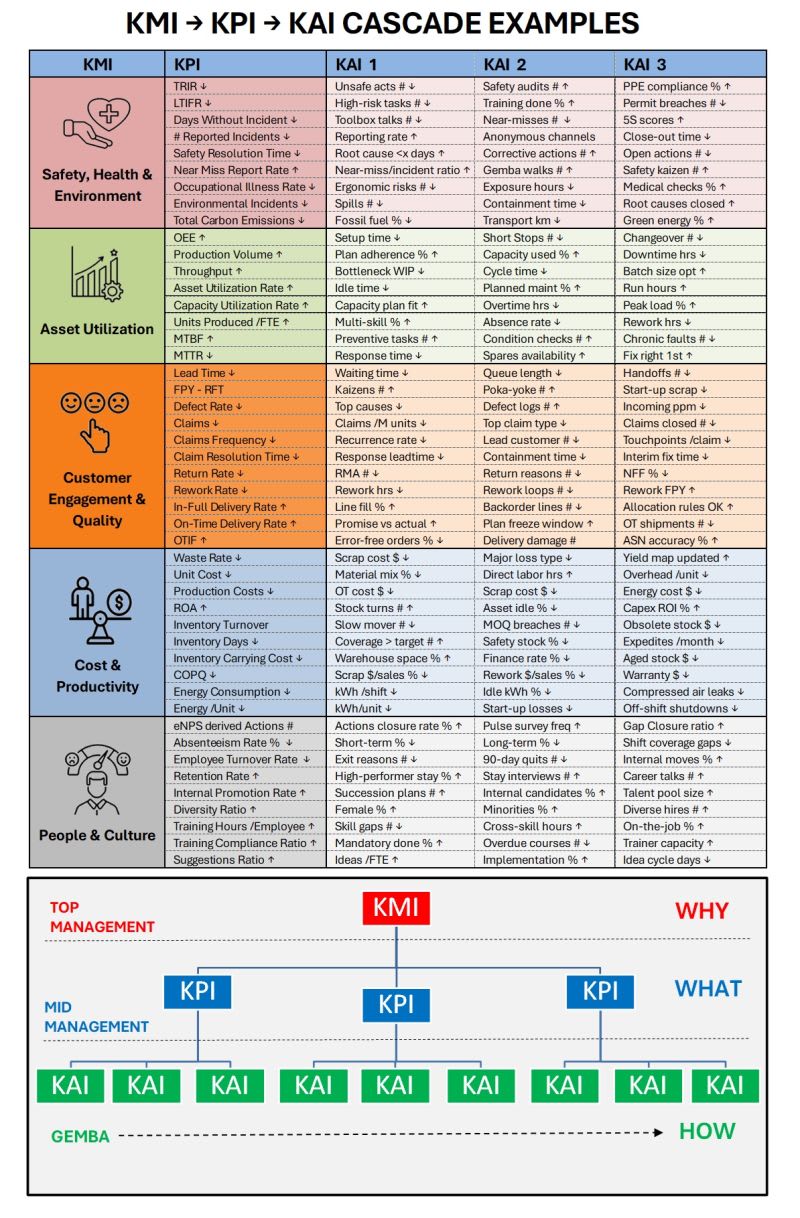
Source: Credit to Alper Ozel
KMI → KPI → KAI Cascade Examples
Emin Tagiyev
Mining Engineering student at SOCAR 16/10/2025

Maximizing Output and Efficiency in Q4 Operations

A Q4 Production Optimization Project built on *A Multi-Objective Optimization Model Using Improved NSGA-II for Optimizing Metal Mines Production Process* aims to push the mine’s existing system to its maximum potential in the final quarter of the year. This approach focuses on short-term but high-impact improvements that can increase production efficiency, profit, and resource utilization using real operational data. The study from the **Huogeqi Copper Mine** (published in *Processes, MDPI*) provides a solid framework for such optimization. It defines three critical decision variables: **geological cut-off grade, minimum industrial grade**, and **loss ratio**—factors that directly influence economic benefit and resource efficiency. The improved **NSGA-II (Non-dominated Sorting Genetic Algorithm II)** algorithm is used to process large datasets and find the best trade-offs between two main objectives: **maximizing profit** and **improving resource utilization**. Unlike traditional single-objective methods, NSGA-II creates a **Pareto front**, a set of optimal solutions that show how one objective can improve without significantly worsening the other. The study revealed that small, precise adjustments in mine parameters could increase profit by **about 2.99%** and resource utilization by **around 2.64%** compared to the mine’s actual performance. This proves that optimization during Q4 doesn’t require major capital investment—just smarter decision-making. In practical Q4 operations, engineers and managers can apply the same method. They start by gathering current mine data—production rates, grades, energy use, and equipment performance. Then, using the optimization model, they test various scenarios. For example, slightly **lowering the cut-off grade** can bring more ore into the mill if processing costs are under control. Adjusting the **industrial grade** threshold ensures the plant processes material at the best efficiency, while optimizing the **loss ratio** helps reduce wasted ore in extraction or processing. The NSGA-II algorithm helps compare all these possibilities and rank them based on performance impact. In **underground mining**, this approach can optimize stope sequencing, ventilation distribution, and mucking cycles to achieve smoother operations and higher tonnage. In **open-pit mining**, it can optimize haul road gradients, bench design, and truck dispatching to cut down idle time and energy use. The algorithm’s adaptability means it can simulate both short-term (daily or weekly) and long-term (quarterly or yearly) targets, making it ideal for Q4 where fast results matter most. The key strength of the NSGA-II-based optimization is its ability to process conflicting objectives at once—like increasing output without compromising sustainability or overusing equipment. By applying it in Q4, mine planners can quickly identify where the system is underperforming and implement changes that produce measurable improvements before the year closes. This makes it not only a performance-boosting project but also a **strategic preparation tool for the next year’s operational plan**. Ultimately, a Q4 Production Optimization Project following this model uses real data, computational intelligence, and practical engineering to transform end-of-year pressure into measurable gains. It enhances the mine’s economic performance, ensures better resource utilization, and supports long-term sustainability goals—all while keeping within the constraints of existing resources and time. The improved NSGA-II framework acts as a decision-support tool that shows which levers to pull and how far, giving managers clear direction on where the greatest return can be achieved in the shortest possible time.

ZVENIA Mining
Corporate at ZVENIA 25/06/2025

5 Layers of Operational Excellence

90% of companies stall before they scale. Not because the market shifted. Not because the team isn’t capable. And definitely not because of a lack of vision. They stall because their operations can’t keep up with their growth. I’ve seen it over and over. The CEO is still making too many decisions. Processes live in people’s heads. Everyone’s working hard, but execution is inconsistent. So the team starts spinning. Firefighting replaces focus. And big goals turn into reactive checklists. When that happens, the fix isn’t more hustle. It’s operational discipline. But here’s the part most people miss: Operational excellence isn’t one big change. It’s a layered process. Built step by step. You start with standardization. Create one clear way to do the work. No more “everyone has their own method.” Then you move to automation. Eliminate repetitive tasks. Free up time for deeper work. Next comes measurement. Track the right numbers. Make them visible. Let the data guide your decisions. Then, layer in continuous improvement. Small weekly fixes. Fast iterations. Constant learning. Only then are you ready for real innovation. Not chaos disguised as creativity. Bold ideas that stick, scale, and move the business forward. This isn’t a theory. It’s how strong, sustainable companies actually scale. From startups to 8-figure teams, the pattern is the same. Build the layers in order. Tighten the engine before you step on the gas.

Source: Credit to Eric Partaker
5 Layers of Operational Excellence
ZVENIA Mining
Corporate at ZVENIA 10/05/2025

Como Estas Estructurando la EDT de tu Proyecto?

¿𝗖𝗢́𝗠𝗢 𝗘𝗦𝗧𝗔́𝗦 𝗘𝗦𝗧𝗥𝗨𝗖𝗧𝗨𝗥𝗔𝗡𝗗𝗢 𝗟𝗔 𝗘𝗗𝗧 𝗗𝗘 𝗧𝗨 𝗣𝗥𝗢𝗬𝗘𝗖𝗧𝗢? Una EDT (Estructura Desagregada del Trabajo) mal organizada puede complicar todo: la planificación, el control, los reportes y hasta los reclamos. Pero si eliges correctamente su estructura, puedes facilitar la gestión del alcance, los costos y los entregables desde el inicio. En esta infografía te muestro 5 formas efectivas de estructurar la EDT según el tipo de proyecto de construcción: ✔️ Por fases del proyecto (EPC) ✔️ Por áreas físicas ✔️ Por fases específicas ✔️ Por disciplinas técnicas ✔️ Por sistemas constructivos 📌 Cada una tiene su aplicación ideal. La clave está en adaptar la EDT a la lógica real del proyecto, no al revés.

Source: Credit to Arnaldo Gonzalez
Como Estas Estructurando la EDT de tu Proyecto?
ZVENIA Mining
Corporate at ZVENIA 25/04/2025

Daily Management System (DMS) / Asakai

Daily Management System (DMS) or in Japanese Asakai is a structured approach to managing day-to-day operations that focuses on continuous improvement and loss (muda) reduction. Definition of DMS/Asakai : A Daily Management System is a set of practices and tools that enable companies to: 1️⃣ Monitor performance daily 2️⃣ Identify areas for improvement 3️⃣ Take corrective actions quickly 4️⃣ Align KPI’s w/ operational execution 5️⃣ Standardize management processes 6️⃣ Establish standard work 7️⃣ Foster a culture of continuous improvement DMS/Asakai is typically executed through a tiered structure: ➡️ Tier 1 (Team Level): - Daily huddles (5-15 minutes) at the start of each shift - Review of key performance indicators (KPIs) - Discussion of issues and quick problem-solving ➡️ Tier 2 (Supervisory Level): - Daily meetings (15-30 minutes) with team leaders - Review of escalated issues from Tier 1 - Coordination of cross-functional problem-solving ➡️ Tier 3 (Management Level): - Daily meetings (30-45 minutes) with supervisors and managers - Review overall performance and strategic alignment - DMS/Asakai Actions follow up - Review and decision making for escalated issues from Tier 1-2 - Resource allocation and improvement initiatives follow up Key components ✅ Visual management boards displaying KPIs and action items ✅ Standard work for leaders at each level ✅ Gemba walks to observe processes and identify improvement opportunities ✅ Problem-solving methodologies (Root Cause Analysis) ✅ Escalation processes for unresolved issues How DMS/Asakai helps ☑️ Enhances equipment reliability by quickly identifying and addressing maintenance issues ☑️ Improves overall equipment effectiveness (OEE) through daily monitoring and rapid problem-solving ☑️ Reduces unplanned downtime by promoting proactive maintenance ☑️ Increases employee engagement and ownership in continuous improvement efforts ☑️ Aligns daily activities with strategic goals, ensuring focus on critical areas ☑️ Facilitates knowledge sharing and best practice adoption across the organization ☑️ Promotes a culture of accountability and data-driven decision-making By implementing a robust Daily Management System, companies can sustain their performance, driving operational excellence and continuous improvement throughout the enterprise. *Below dash is just an example, details/content may vary based on company metrics/strategic priorities.

Source: Credit to Alper Ozel
Daily Management System (DMS) / Asakai
ZVENIA Mining
Corporate at ZVENIA 31/03/2025

Risk Priority Number (RPN)

RPN is a numerical score used in Failure Mode and Effects Analysis (FMEA) to evaluate and prioritize risks associated with potential failure modes of a product or process. It helps teams focus on the most critical risks that need to be addressed. 🔢 Formula for RPN: RPN = Severity (S) × Occurrence (O) × Detection (D) -Severity (S): The potential impact of a failure. -Occurrence (O): The likelihood of the failure occurring. -Detection (D): The ability to detect the failure before it reaches the customer. Each of these factors is rated on a scale (usually 1 to 10), and the RPN score is the product of these ratings. ⚖️ Prioritizing Risk by 3 Factors: -Severity: How severe the failure would be. -Occurrence: The likelihood of the failure happening. -Detection: How likely the failure will be detected before it affects the customer. 📊 Risk Matrix: A Risk Matrix helps visualize and prioritize risks based on their Severity and Occurrence ratings, while the Detection rating influences how proactive we need to be in addressing those risks. 🔴 Color Coding in Risk Matrix: -Red: High risk, immediate action needed. -Yellow: Moderate risk, requires attention. -Green: Low risk, monitoring required. ✅ Benefits of RPN Matrix: -Provides a systematic way to evaluate and prioritize risks. -Helps allocate resources more effectively by focusing on the most critical risks. -Enhances decision-making by providing clear risk ratings. ⚠️ Disadvantages of RPN: -RPN does not always reflect the true level of risk, especially when factors like severity are not accurately considered. -Two failure modes with the same RPN may require different actions. -Over-reliance on RPN can lead to missing out on other critical aspects of risk. 🔑 Recommendations: - Combine RPN with Severity, Occurrence, and Detection ratings for a more accurate risk prioritization. - Use tools like FMECA for a more detailed and comprehensive risk analysis. Regularly update risk ratings to reflect new data and changes in operational conditions. Source: https://www.linkedin.com/in/govind-tiwari-phd/

Source: Credit to Govind Tiwari
Risk Priority Number (RPN)
ZVENIA Mining
Corporate at ZVENIA 15/03/2025

¿Sabías que los pequeños cambios pueden generar grandes resultados?

El Método Kaizen es una filosofía de mejora continua que ha transformado la forma en que las empresas optimizan sus procesos y mejoran la calidad. 🔍 1. Identifica Oportunidades de Mejora: Revisa tus procesos actuales y detecta dónde puedes optimizar. 👥 2. Conforma un Equipo de Trabajo: Involucra a todos los que participan en el proceso para obtener ideas valiosas. 📊 3. Evalúa la Situación Actual:Analiza cómo se realizan las tareas hoy en día para comprender el flujo de trabajo. 💡 4. Desarrolla Soluciones Innovadoras: Prioriza ideas simples y rápidas de implementar para mejorar el proceso. ⚙️ 5. Implementa el Cambio: Asegúrate de que todo el equipo esté informado y capacitado en los nuevos procedimientos. 📈 6. Monitorea y Evalúa:Observa el impacto de los cambios y ajusta según sea necesario. 🔄 7. Estandariza y Repite: Si los cambios han sido exitosos, estandariza y sigue buscando nuevas oportunidades de mejora. La clave está en la constancia y en involucrar a todos los niveles de la organización. ¡Cada pequeño paso cuenta hacia un gran cambio!

Source: Credit to Andrés Santacruz
¿Sabías que los pequeños cambios pueden generar grandes resultados?
ZVENIA Mining
Corporate at ZVENIA 26/02/2025

12 pasos para lograr un KPI perfecto

¿Sabías que los KPIs (Key Performance Indicators) son esenciales para el éxito empresarial? 🤔📈💼 Son métricas clave que permiten medir el rendimiento y tomar decisiones estratégicas. Sin ellos, sería imposible saber si se están alcanzando los objetivos o si es necesario ajustar la estrategia. 📊 ¿Por qué son tan importantes los KPIs? ✔️ Evalúan el progreso hacia los objetivos. ✔️ Identifican áreas de mejora y oportunidades de crecimiento. ✔️ Permiten monitorear el rendimiento del equipo. ✔️ Ayudan a mantener el enfoque en lo que realmente importa. 🔹 12 pasos para un KPI efectivo 🟢 Nivel Básico: 1️⃣ Definir el nombre del KPI. 2️⃣ Alinear el KPI con un objetivo estratégico. 3️⃣ Establecer el valor, referencia y meta. 4️⃣ Diseñar el proceso de recopilación de datos. 🔵 Nivel Experto 5️⃣ Identificar indicadores clave. 6️⃣ Definir el peso del KPI. 7️⃣ Acordar la frecuencia de actualización. 8️⃣ Establecer la fecha de caducidad. 9️⃣ Calcular el costo de seguimiento. 🔟 Asignar roles y responsabilidades. 1️⃣1️⃣ Definir escenarios de uso. 1️⃣2️⃣ Analizar la diferencia entre proyección y realidad.

Source: Credit to Felipe Israel González Lastré
12 pasos para lograr un KPI perfecto
ZVENIA Mining
Corporate at ZVENIA 24/01/2025

Most change fails in some way or another

Here’s why (and how to fix it) ⬇️ Why does most change fail? It’s not because people resist change. It’s because leaders miss one (or more) critical ingredients: ❌ No vision? The team doesn’t know where they’re headed - causing confusion. ❌ No skills? People feel overwhelmed and anxious about their ability to deliver. ❌ No incentives? Without clear motivation, resistance builds quickly. ❌ No resources? Frustration sets in when people don’t have what they need. ❌ No action plan? You’ll see false starts and repeated mistakes. But when you get all these factors right, change becomes possible: ✅ A clear vision inspires the team and aligns their efforts. ✅ Building the right skills empowers people to contribute effectively. ✅ Meaningful incentives keep everyone motivated and engaged. ✅ Providing the necessary resources ensures a smooth path forward. ✅ A strong action plan keeps the team focused and on track. Change isn’t about luck - it’s about preparation and execution. 🧠 Remember; without all five pieces, even the best ideas will fail to stick. What’s your biggest challenge when driving change?

Source: Credit to Sean McPheat
Most change fails in some way or another
ZVENIA Mining
Corporate at ZVENIA 25/10/2024

50 Business Diagrams for Strategic Planning (56 pages)

🌟 Boost Your Strategic Planning with Essential Business Diagrams 🌟 In today's dynamic business environment, having the right tools is key to making informed decisions. 📊 Whether you’re managing projects, enhancing processes, or optimizing business strategies, having a visual aid can make all the difference! Here are some must-have business diagrams for strategic planning and analysis: Affinity Diagram: Perfect for organizing ideas from brainstorming sessions and identifying patterns. Decision Tree: Helps break down complex problems into manageable steps, leading to optimal decision-making. Value Stream Map: Ideal for visualizing and improving the flow of materials and information in your processes. SWOT Analysis: An essential tool for identifying your business’s strengths, weaknesses, opportunities, and threats. PEST Analysis: Analyze the external macro-environment factors to help your business stay ahead of the curve. Visual tools like these not only streamline your decision-making process but also foster collaboration and innovation within teams. Want to make smarter, data-driven decisions? Start leveraging these business analysis tools today! Source: Mohamed Mohamed Hossam, FMVA®, FTIP™, MBA, PFAD

Source: Credit to Creately

Preview of ZVENIA Mining

Sign up to get unlimited content. No credit card needed.

Sign Up Free