Mining researchers have debated this for decades, and the answer is remarkably consistent.
A waiting truck is cheaper than a waiting excavator. Why?
An excavator is the production engine of an open cast mine. It is one of the most expensive assets on site, with high ownership costs, high fuel consumption, and a production rate that directly determines how many tonnes can be moved.
If an excavator is waiting for trucks, production stops. If a truck is waiting for an excavator, production continues the moment it is loaded.
This is why many mine planning studies recommend keeping excavators busy, even if it means trucks spend some time in a queue.
That doesn't mean long truck queues are acceptable. Excessive queuing increases cycle time, fuel consumption, tyre wear, and operating cost.
The objective is to keep the shovel digging and keep truck queues short.
That balance is where the lowest cost per tonne is achieved.
Reference: Principles discussed in surface mine fleet optimization research by SME, Caterpillar performance studies, and Hustrulid & Kuchta's Open Pit Mine Planning and Design.
⛏RESOURCE IS A GEOLOGICAL NUMBER. RESERVE IS A BUSINESS DECISION.
One of the biggest misconceptions in mining is assuming that a resource automatically becomes a reserve.
A mineral resource represents what geology tells us exists beneath the ground. It is a measure of quantity, grade, and confidence based on exploration data and geological interpretation.
A mineral reserve, however, is something very different.
A reserve is the result of technical, operational, economic, environmental, and strategic decisions. It represents the portion of a resource that can be mined profitably and sustainably under real-world conditions.
This is where multidisciplinary collaboration becomes essential:
🔹 Geologists define what exists and quantify uncertainty.
🔹 Mining Engineers evaluate mineability, dilution, recovery, slope constraints, and operational practicality.
🔹 Processing Specialists assess metallurgical recovery and product quality.
🔹 Business Leaders and Investors evaluate risk, capital allocation, market conditions, and long-term project value.
The most successful mining projects are not necessarily those with the largest resources, but those that make the smartest reserve decisions.
Patience also plays a critical role.
Rushing resource conversion without sufficient data, proper technical assessment, or economic validation often leads to unrealistic expectations and poor outcomes. Mature decision-making requires understanding that every assumption—whether geological, operational, or financial—can significantly impact project value.
In mining, value is not created by discovering tonnes alone.
Value is created when technical knowledge, sound policy, operational discipline, and strategic thinking work together to transform geological potential into sustainable profitability.
Great reserves are not found. They are engineered through the right decisions.
#Mining #MineralResources #MineralReserves #MinePlanning #ReserveEstimation #MiningEngineering #Geology #Geometallurgy #MiningBusiness #ResourceModeling #TechnicalServices #MiningIndustry #ZVENIA #MiningKnowledge
Definition:It is the ratio of the volume or weight of overburden (OB) removed to the volume or weight of ore or coal extracted in a surface mine.
SR=OB Removed (M³)/Ore or Coal Extracted (Tonnes)
• A lower SR means more economical mining; a higher SR increases cost.
🔸Types of the SR:
1.Overall Stripping Ratio(OSR): It is the total quantity of OB removed divided by the total quantity of Ore/Coal mined during entire life of mine,Used for long-term planning.
OSR=Total OB removed÷Total ore/coal mined during the mine’s life
2.Instantaneous or Bench SR (ISR or BSR): It is the ratio for a specific portion or bench of the mine,not the entire life,Used for short-term planning & assessing local variations in mine geometry.
3.Break-Even Stripping Ratio (BESR): It represents the max SR at which mining remains economically viable.Beyond this ratio,the cost of removing OB equals or exceeds the value of the ore (No Profit=No Loss).
BESR=Value of Ore-Cost of Ore Mining/Cost of OB Removal
🔸Factors Affecting the SR:
1.Depth of Ore Body: Deeper deposits→ higher SR.
2.Thickness of Seam: Thicker seams→lower SR.
3.Dip of Seam: Steeper dips→higher SR.
4.Nature of OB: Hard/compact OB→increases SR cost.
5.Ore Body Shape & Continuity: Irregular or faulted ore→higher SR.
6.Mining Method & Equipment: Efficient,high-capacity machines→lower SR.
7.Haulage Distance: Longer haul→increases SR cost.
8. Market Price of Ore/Coal: Higher price allows higher SR to remain economic.
9.Cost of OB Removal: Higher removal cost→lower acceptable SR.
10.Groundwater & Drainage: Poor drainage→more OB handling→higher SR.
11.Mine Planning & Scheduling: Proper planning reduces SR;early stages often have higher SR.
🔸Need for Determining SR: Determining the SR is essential because it helps in:
1.Economic Feasibility: To know if mining is profitable or not.
2.Mine Planning & Design:Helps determine the Ultimate Pit Limit (UPL),pit depth & layout,selecting the most suitable mining method and equipment capacity.
3.Production Scheduling: Guides annual stripping and ore production targets.Helps maintain a balance between OB removal and ore extraction.
4.Cost Estimation and Budgeting: SR provides the basis for estimating OB handling costs,unit cost of production and preparing project budgets.
5.Environmental and Safety Compliance: Determines the volume of waste to be handled,dumbed & backfilled.Affects slope design,reclamation planning & stability analysis.
6.Decision on Cut-off Grade and Pit Limit: Helps establish the BESR & Final boundaries of the pit (i.e.UPL).
7. Equipment & Resource Planning: Used to select suitable machine & manpower requirements based on waste-to-ore ratio.
•1.5:1 – Manual quarrying
•2:1 – Semi-mechanized quarrying
•3 to 4:1 – Bucket Wheel excavator
•4 to 5:1 – Shovel-Dumper combination
•8 to 10:1 – Dragline method
The SR is a key economic indicator that determines the feasibility, profitability, mine design, pit depth & life of a mining project.
En los estudios económicos de un proyecto minero, las reservas juegan un rol crítico en la valorización del mismo.
En el gráfico, se muestra cómo una variación del 1% en las reservas minerales (por tonelaje o ley) puede modificar el NPV en aproximadamente $6.2 millones de dólares. Esta relación proporcional evidencia la alta sensibilidad del NPV frente a las reservas.
En este ejemplo se tiene un NPV base de 288 millones de USD. Una disminución del 30% en las reservas podría reducir el NPV a 105, mientras que un aumento del 30% lo elevaría hasta 474 millones.
📊 Fuente: Mining Project Value Optimization
A Practical Reflection on Hidden Costs, Precision Engineering, and Operational Survival
This week, I revisited a robust technical report on operational costs in mining. The document, published by the respected SRK Consulting, is a valuable compendium: it details costs by activity, separates fixed and variable expenses, and discusses methodologies such as Activity-Based Costing (ABC), among other essential practices for reducing expenses and maximizing value.
However, one thing caught my attention: there was no mention of the cost of error — the kind that doesn’t appear directly on spreadsheets, but is paid for through rework, metallurgical losses, poorly executed blasts, geotechnical instability, or even irreversible social and environmental impacts.
I couldn’t help but recall 2019, when I was in Chile for a summer internship, visiting a low-grade iron ore operation. In that challenging context, margins were so tight that attention to every detail made a difference, and all quality and uncertainty control systems (QA/QC) were tuned to the highest level. I witnessed precision engineering being used as a tool for economic survival. In that setting, error simply wasn’t an option.
At that moment, I realized a stark contrast with the mindset I’ve often seen in Brazil: the idea that "errors can be absorbed", a mentality historically supported by high ore grades and a more forgiving market environment. But that reality no longer exists. Today, mining operations in Brazil are subject to much stricter demands for precision, control, social responsibility, and sustainability.
So, the big questions are:
👉 How much does an error really cost?
👉 What is the impact of uncertainty on our decisions?
👉 Why is there still resistance to modeling uncertainty as a strategic cost?
As my professor Joao Felipe Costa wisely says:
“Error exists, and our role is to quantify the space of uncertainty.”
And he’s absolutely right.
There are now statistical models, geotechnical systems, sensors, simulations, and algorithms that allow us to measure operational risks and uncertainties with remarkable precision. And every percentage point of ignored uncertainty is, in practice, a hidden cost that undermines the competitiveness and sustainability of any operation.
In a sector under pressure from narrow margins and high responsibility, increasing environmental pressure, stricter social demands, and a diversity of political and economic conditions, incorporating the cost of error into decision-making models is no longer a luxury: it’s a technical and ethical urgency. Ignoring the cost of uncertainty is no longer acceptable. It’s time to turn this “invisible Cost” into a strategic indicator.
Claiming certainty without knowing the degree of uncertainty doesn’t eliminate the error.
The error exists — and must be accounted for.
Precision Engineering Is Impact Engineering
We are called to act with excellence and responsibility. We must look beyond the visible CAPEX and OPEX, and include the variables that truly define long-term viability: error, uncertainty, trust in data, and a commitment to social and environmental impact.
That is the kind of engineering I believe in. That is the future I want to help build.
If you believe in this too, let’s talk. 📩 Leave a comment or send me a message.
💬 Let’s turn data into decisions — together.
Since founding Objectivity I’ve discovered that resource drill planning is mostly being done with the assumption that more drilling will lead to more resource classification/definition. More drilling isn't always better in mining. Here is why.
Like many things in mining this is not quite correct and the current process leaves a lot of value on the table. Budget is often set before a full technical assessment (as these tend to evolve during budgeting), there are no clear KPIs, boards/management tend to reduce budgets (because drilling is often the first casualty of cost control) and there are a limited number of options reviewed when making plans. Someone presents a plan with X number of holes, and often the only question asked is “can you add a hole here and there?” or “what can you do with half the budget?”.
Resource development drilling and exploration drilling have very different value drivers. The former benefits from a QP/CP defined sampling criteria that will guide the resource drilling plan’s layout. Unfortunately spacing is a great criteria for a time when holes were planned in 2D on mylar.
But what if I told you that in most cases, you could achieve the same expected resource conversion with 30% fewer drill holes, while meeting QP/CP sampling requirements? You'd probably say: "That's not possible."
When we analyze resource conversion efficiency, we see a curve that looks like this: as you add more drill holes, the percentage of volume potentially converted increases, but not linearly. Drilling from 10,000 to 13,000 meters can improve resource conversion by 24%, but then adding another 3,000 meters yields only an additional 7% (data courtesy Adventus Zinc @Curipumba). The curve always flattens dramatically after a certain point, reducing incremental value.
This is the investment curve that highlights a critical point of diminishing returns that most drilling programs blow right past.
This is sensitivity analysis for your resource drilling - sensitivity analysis is always expected at the feasibility study stage yet seldom used for an activity that is on every mining/late stage exploration project’s critical path.
Would you make better decisions with multiple plans objectively assessed against key criteria, or with just a single plan? The answer seems obvious, yet most companies stick to the single-plan approach citing, “no time”, “no people”, “shifting criteria”.
Still skeptical? Good, skepticism is healthy. But why not put us to the test? We are confident that we can change how you think about resource drilling and the value that it produces. Increasing conversion efficiency, while respecting QP/CP requirements, will make our industry more financially efficient. Show us your data and we'll show you a range of solutions to help make objective based investment decisions.
Begin optimizing your investment here:
https://docs.google.com/forms/d/e/1FAIpQLSe8JdRWRB5MK9gnzJbk3FQZu17dFmWyUkre8S2yXo_k0l2HIw/viewform
This file is a step-by-step guide that explains how mining works, from the very beginning until the final product is ready. It starts with mine development, where the mine is built and prepared. Then it goes through each stage like drilling, blasting, loading, hauling, ventilation, crushing, mineral separation, and waste management.
For every step, the file explains:
* What kind of work is done
* What machines and systems are used
* What safety measures are needed
* What the costs are (fixed and variable)
It’s written in simple words, so it’s easy to understand for students, new engineers, or anyone interested in the mining industry. It also shows how important planning, safety, and cost control are in mining operations.
This guide can be useful for:
-Mining and geology students
-People working in mines or planning to work in this field
-Anyone curious about how raw materials are taken from the earth and turned into useful products
Opening a new mine or expanding an existing operation can be a challenging and daunting task. Aside from assessing and evaluating social-environmental concerns and designing the mining and material movement approach, the first question often asked is, "how much will it cost us to mine?" This may need to be determined even before you decide that there is a potential project. Mine cost estimation may be done at many levels. At first it may be a simple “back of the envelope” estimation using similar operations to benchmark against. Later it may be decided to use an existing mine that the company owns and factor and compare costs against them. In the final stages a detailed bottom-up estimation based on first principles may be completed.
This paper will investigate common methodologies of estimating operating costs for mines and present examples from actual operations and why those methods were selected. It will highlight why some methods are superior to others. Finally, we will explore the potential pit falls in cost estimation that often occur and the opportunities that may exist to lower mine costs.
Source: Credit to: Gary Poxleitner - SRK Consulting
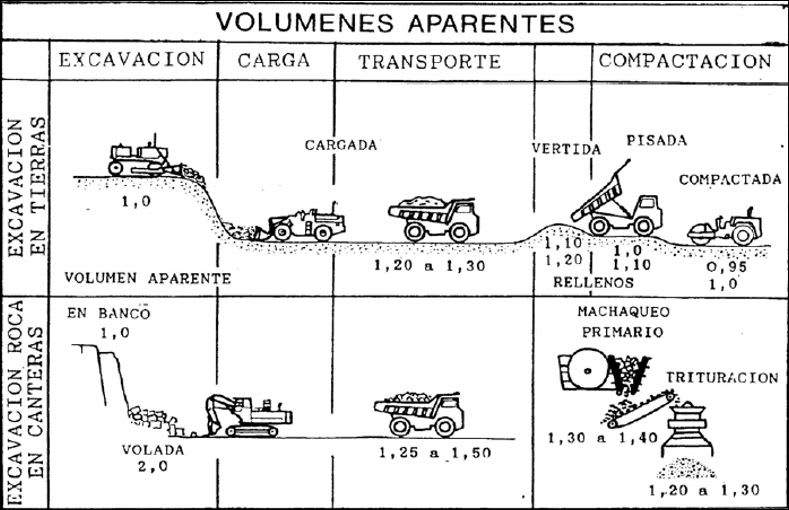
Hoy quiero hablar de un concepto fundamental que impacta directamente en la planificación, costes y ejecución de nuestros proyectos: los Volúmenes Aparentes.
Sabemos que 1 m³ de material in situ (en su estado natural) rara vez ocupa el mismo volumen una vez excavado, transportado o compactado. ¡Comprender estas variaciones es crucial!
Tomando como base 1.0 el volumen del material in situ:
1️⃣ EXCAVACIÓN / VOLADURA:
Tierras: Al excavar, el suelo se suelta y sufre un esponjamiento. Su volumen aumenta, pasando de 1.0 a aproximadamente 1.20 - 1.30.
Roca (Canteras): Tras la voladura, la fragmentación es mayor. El volumen puede incrementarse significativamente, ¡llegando a 2.0 respecto al banco original!
2️⃣ CARGA Y TRANSPORTE:
El material mantiene o incluso ajusta ligeramente su volumen esponjado.
Tierras cargadas/transportadas: Se mantienen en el rango de 1.20 - 1.30.
Roca volada cargada/transportada: El volumen puede ser de 1.25 - 1.50 (ya algo asentada respecto al momento justo post-voladura).
3️⃣ PROCESOS FINALES:
RELLENOS Y COMPACTACIÓN (Tierras):
Vertida (Rellenos sin compactar): Al descargar, el material se asienta un poco, situándose en 1.10 - 1.20.
Pisada/Pre-compactada: Un primer paso de compactación lo lleva a 1.0 - 1.10.
Compactada: Con la maquinaria adecuada, buscamos reducir vacíos y aumentar la densidad. El volumen final puede ser 0.95 - 1.0, ¡incluso ligeramente inferior al original si la compactación es muy eficiente!
CHANCADO/TRITURACIÓN (Rocas):
Chancado Primario: La roca procesada aún presenta un volumen superior al original en banco, alrededor de 1.30 - 1.40.
Trituración (Fina): El producto final triturado sigue teniendo un volumen aparente mayor al in-situ, típicamente 1.20 - 1.30.
¿Por qué es vital este conocimiento?
📊 Cálculo de volúmenes: Para saber cuántos viajes de camión se necesitan.
💰 Estimación de costes: Afecta directamente los costes de excavación, transporte y disposición.
🛠️ Selección de maquinaria: El volumen real a manejar influye en la capacidad de los equipos.
📈 Planificación de obra: Optimiza los espacios de acopio y la secuencia de trabajos.
Conocer y aplicar correctamente los factores de esponjamiento y compactación es un pilar para el éxito y la rentabilidad de nuestros proyectos.
Source: Credit to Ricardo Espinoza Segura
1
12 Economics and costs
Covers financial evaluation of mining projects, including costs, revenues, cash flow, and economic indicators.
Workshops on mining economics, budgeting, and financial analysis.
No events scheduled
12 Economics and costs
Covers financial evaluation of mining projects, including costs, revenues, cash flow, and economic indicators.
Financial experts discuss project economics and market impacts.
No podcasts yet
12 Economics and costs
Covers financial evaluation of mining projects, including costs, revenues, cash flow, and economic indicators.
Economic studies, cost modeling, and financial advisory services.
No solutions found
1 / 1
Where expertise has an address.
Register your expertise once. Be findable by specialty across 25 domains and 76 countries.