


Posts Header

11 Resource estimation

Focuses on geological modeling and estimation methods used to quantify mineral resources.

Technical articles on geostatistics, variography, kriging, simulations, and reporting codes.

ZVENIA Mining
Corporate at ZVENIA 12/02/2026
A common mistake I see in mining project reviews — Resource Classification

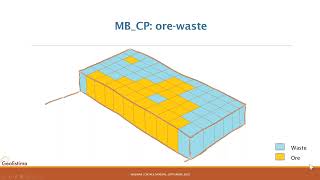
Reviewing mining projects from discovery through to operations, there’s one issue that comes up time and time again: resource classification. Teams spend countless hours on estimation methods and geological interpretation, only to fall short when it comes to correctly classifying the resource. Why does it happen? Optimism bias (often driven by board or funding expectations) Time pressure at the end of a study Inexperience with classification standards Or simply underestimating how critical classification really is As an external reviewer, here are a few practical principles that consistently separate robust resource models from risky ones: 🔹 Let drill spacing lead the classification Be strict. If there are spacing gaps, classify them accordingly. No “spotted dogs”. 🔹 Avoid circles around drill holes Resources aren’t radial. Use orebody knowledge and geological controls to define realistic shapes. 🔹 Data integrity matters QAQC results, core recovery, and missing samples must be reflected in the classification. Confidence in tonnes starts with confidence in data. 🔹 Respect the limits of your estimation parameters Search radii, variography, and interpolation choices should cap — not inflate — classification confidence. 🔹 Classify waste properly If the drill spacing supports a measured ore classification, the same logic applies to internal waste. Mining companies want to know where measured waste is — ironically, we mine far more waste than ore. Resource classification isn’t a tick-box exercise. It’s a risk statement, and decision-makers rely on it more than we often acknowledge. Get it right early, and everything downstream — mine design, scheduling, economics — becomes stronger. Happy to discuss or hear how others approach this challenge in their projects.

Source: Credit to Stephanie Bream
A common mistake I see in mining project reviews — Resource Classification
ZVENIA Mining
Corporate at ZVENIA 29/10/2025
From the Witwatersrand Mines to Machine Learning

It all began in the South African gold mines in the 1950s. An engineer named Danie Krige was frustrated by the inaccuracy of reserve estimates. The manual methods of the time were subjective, inconsistent and led to costly mis‑judgements. The problem was simple yet crucial: how could one estimate the grade of millions of tonnes of ore based on only a few hundred drill holes? 🔹 The solution came from France: Georges Matheron, a French mathematician, was struck by Krige’s empirical work. In 1962 he formalized the mathematical theory behind Krige’s observations, creating what we now know as kriging. The kriging revolution: Unbiased estimates with minimal variance Quantification of uncertainty through the kriging variance A rigorous statistical method replacing specialists’ “gut feeling” A mathematical foundation based on variograms and spatial correlation Transformational impact: Kriging was not merely an incremental improvement-it was a paradigm shift. For the first time in the history of mining, there was a method that not only estimated grades but also quantified the confidence placed in those estimates. 🔹 Concurrently, another revolution: In 1965, Helmut Lerchs and Ingo Grossmann solved another fundamental problem: what is the optimal pit? Their algorithm, based on graph theory, provided for the first time a mathematically optimal solution for delineating open pits. Before: manual pit design based on experience. After: mathematical optimization ensuring maximum economic value. The perfect marriage: Kriging provided reliable grade estimates. The Lerchs–Grossmann algorithm optimized economic recovery. Result: scientific planning in place of intuition. A historical note: the Lerchs–Grossmann algorithm only became widespread twenty years later, once computers were powerful enough. The Whittle 3D software of the 1980s was the milestone that democratized pit optimization. Why does this matter today? These two pillars-reliable estimation and mathematical optimization-laid the foundation of modern mining. Without them, we would not have the basis to integrate machine learning, stochastic simulation and advanced optimization, as we see today. The journey continues: 1960s: Kriging + Lerchs–Grossmann 1980s: Stochastic simulation 2000s: Optimization under uncertainty 2020s: Machine learning + geostatistics From South Africa to the world, from intuition to science, from deterministic to probabilistic methods.

Source: Credit to Anuar Bergamaschi Pires
From the Witwatersrand Mines to Machine Learning
Mohamed Coulibaly
Mining Engineering at LMSA 13/10/2025

Dilution Minière

La dilution minière est l'un des facteurs les plus importants affectant l'économie des projets miniers. Bien que nous fassions de notre mieux pour identifier et calculer tous les autres éléments de coût d'un projet, aussi petits soient-ils, il est courant de formuler des hypothèses générales sur la dilution au lieu de la quantifier. Cela est généralement dû à un budget insuffisant, à du temps pour les études et également à l'absence d'une méthodologie bien définie pouvant être utilisée. Au lieu de quantifier la dilution dans les études minières, il est courant de supposer une dilution générale telle que 5% pour les gisements massifs et 10% pour les gisements de forme tabulaire. Bien que ces chiffres puissent être un bon point de départ dans les premières étapes des études minières, ils ne prennent pas en considération la complexité du problème.

ZVENIA Mining
Corporate at ZVENIA 12/10/2025

The New Mineral Resource Classification being Debated

🫵 The plot Conservative practices contribute to substantial economic inefficiencies in the mining sector. Industry-wide impairment losses exceeded $120 billion during the 2013/14 commodity downturn, with resource and reserve estimation issues identified as contributing factors in 17% of feasibility study failures. McKinsey estimates $100 billion in potential value optimization across mining feasibility studies, with resource classification standards identified as one element requiring improved rigor. 🫵 The dirty little secret Ore deposit valuation hinges on robust reserve estimation, yet prevailing mining standards conflate geological confidence with grade uncertainty, leading to conservative biases and undervaluation. Geostatisticians often downgrade resources by focusing on local grade variability, ignoring geological reliability established in Indicated Resource classifications resulting in reduced reserves, deterring investment despite solid deposit foundations. The evaluation and valuation of ore deposits too often undermined by the conflation of geological confidence with grade uncertainty. 🫵 The gatekeepers labyrinth The classification of mineral resources and reserves has long struggled with this in both resource management and deposit valuation. Current practices, under the CRIRSCO umbrella, geostatisticians override established geological assurances based solely on grade variability, resulting in unnecessary reductions in reported ore reserves. Decoupling these risks and employing statistical confidence intervals, mining can preserve reserve estimates, capture upside potential, and enhance valuation accuracy. 🫵 Clear precedent The petroleum industry's Proven-Probable-Possible framework (PRMS), assigns explicit confidence intervals to reserve estimates without abandoning sound geological interpretations. The framework addresses both mineral resource classification requirements and deposit valuation imperatives, recognizing that classification decisions directly influence market valuations, access to capital, and investment returns. Such an approach recognizes that resource classification decisions directly impact deposit valuations, making the conversion of Mineral Resources Reserves relevant to the valuation of Mineral deposits. Ignoring this risk conflation attracts opportunity costs and consequential economic harm to investors because undervaluation of projects of well-understood deposits that receive inappropriate classification due to statistical limitations rather than geological uncertainty can be significant. Downgrading resource categories invokes different valuation multiples in market assessments resulting in poor market valuations that impede access to capital and capital formation. The misallocation of Mineral Resources can trigger the requirement for severe impairments charges that qualified persons seem aloof to.

Source: Credit to Craig Hutton
The New Mineral Resource Classification being Debated
Isaac Nwafor
Geotechnical intern at AOA Geo-net limited 12/10/2025

Resource Estimation in Mining

Resource estimation is a crucial process in the mining industry, serving as the foundation for mine planning, design, and economic evaluation. It involves analyzing geological data to determine the quantity and quality of mineral resources present within a deposit. The process typically begins with geological modeling, followed by geostatistical analysis using techniques such as kriging, inverse distance weighting, and simulation methods. These tools allow geologists to predict grade distribution and spatial variability within the ore body. Accurate resource estimation reduces uncertainty, improves investment confidence, and ensures that extraction remains both technically feasible and economically viable. With the advent of machine learning and 3D modeling software, modern estimations are becoming more precise and dynamic. Ultimately, resource estimation bridges science and strategy turning geological observations into actionable insights that guide sustainable mineral development.

Source: Sinclair, A. J., & Blackwell, G. H. (2002). Applied Mineral Inventory Estimation. Cambridge University Press.
Resource Estimation in Mining
Yedidia Mgema
Resource Geologist consultant at Smart Mining Resource 12/10/2025

Radial Basis Function (RBF) Method for Mineral Resource Estimation

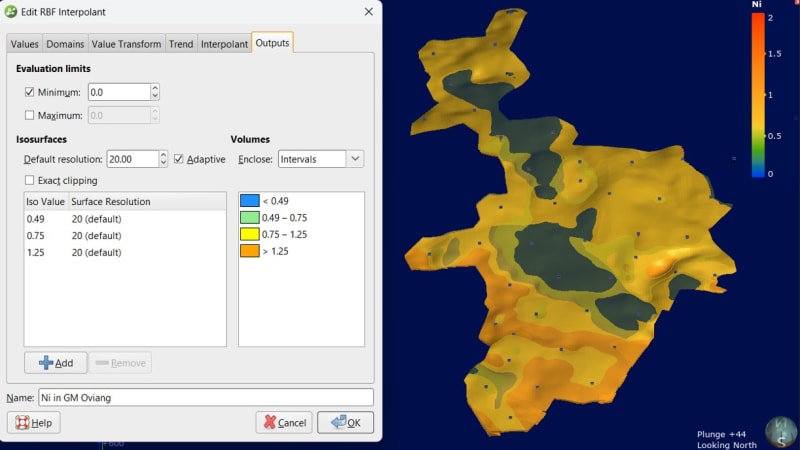
The Radial Basis Function (RBF) interpolation method has emerged as a powerful geostatistical tool for mineral resource estimation, offering flexibility and robustness in modeling complex orebody geometries and grade distributions. Unlike traditional estimation techniques such as Inverse Distance Weighting (IDW) or Ordinary Kriging, RBF utilizes a smooth mathematical function that fits through known data points while minimizing interpolation error. This property enables the method to capture both global and local grade variability with high precision. In this study, the RBF approach was applied to a gold deposit using drillhole assay data to generate a continuous three-dimensional grade model. Various kernel functions—such as multiquadric, Gaussian, and thin-plate spline—were tested to optimize model accuracy and performance. Cross-validation results demonstrated that the RBF model effectively reproduced spatial grade trends and provided smoother, geologically realistic surfaces compared to conventional methods. The resulting block model was validated against composited data and geological interpretations, showing strong correlation and reduced estimation bias. The RBF method proves particularly advantageous in deposits with irregular sampling patterns or non-stationary grade distributions. Consequently, RBF interpolation represents a valuable alternative for modern resource estimation workflows, especially when integrated within advanced 3D geological modeling software such as Leapfrog Geo.

Radial Basis Function (RBF) Method for Mineral Resource Estimation
Lungu Maina josue
Étudiant at Université officielle de Bukavu 25/09/2025

Validation du Modèle de Ressources : Un Aperçu du Gisement Aurifère

Le swath plot ci-joint offre une validation clé de notre modèle de ressources pour le gisement aurifère. Points Clés : Cohérence des Estimations : Les méthodes d'estimation par Inverse Distance (ID) et Kriging (Kr) montrent des tendances de teneur remarquablement similaires (lignes magenta et olive). Cette concordance renforce la fiabilité de notre modèle de blocs. Corrélation Teneur-Volume : Une forte corrélation est observée entre les zones à haut volume de minerai (barres beiges) et les pics de teneurs moyennes. La zone principale du gisement (Swaths 60-90) est clairement identifiée comme la plus riche et la plus volumineuse. Distribution de la Minéralisation : Le gisement présente une minéralisation principale concentrée, avec des variations de teneur bien capturées par le modèle sur l'axe X. Ces résultats confirment que notre modèle de blocs représente fidèlement la distribution des teneurs, un atout essentiel pour la planification minière et l'optimisation de l'extraction. #GéologieMinière #EstimationDeRessources #ValidationDeModèle #ExplorationMinérale #Or

Validation du Modèle de Ressources : Un Aperçu du Gisement Aurifère
ZVENIA Mining
Corporate at ZVENIA 04/09/2025

The JORC Code and NI 43-101

The JORC Code and NI 43-101 are two prominent reporting standards used in the mining industry for resource estimation. Here is a comparison between the two: 1. **JORC Code (Australasian Code for Reporting of Exploration Results, Mineral Resources and Ore Reserves)**: - **Region**: Primarily used in Australasia (Australia and parts of Asia). - **Main Principles**: - It focuses on providing clear guidelines for the reporting of exploration results, mineral resources, and ore reserves. - JORC requires transparent reporting and compliance with defined standards. - **Compliance**: Mandatory for companies listed on Australian stock exchanges. - **Categories**: - Exploration Results, Mineral Resources, and Ore Reserves are classified based on their geological certainty and economic viability. - **Competent Persons**: Reports must be prepared by a "Competent Person" who is a member of a recognized professional organization. 2. **NI 43-101 (National Instrument 43-101)**: - **Region**: Mainly used in Canada. - **Main Principles**: - It aims to standardize reporting on mineral properties to provide investors with clear information. - NI 43-101 ensures fair disclosure, accuracy, and transparency of mineral project information. - **Compliance**: Required for all Canadian companies listed on Canadian stock exchanges. - **Categories**: - Like JORC, NI 43-101 distinguishes between Exploration Results, Mineral Resources, and Mineral Reserves based on confidence levels and economic considerations. - **Qualified Persons**: Reports must be prepared by a "Qualified Person" who is required to be a professional geoscientist or engineer. In summary, both the JORC Code and NI 43-101 are reporting standards that aim to ensure transparency, accuracy, and consistency in reporting exploration results, mineral resources, and ore reserves. While they have similarities in the classification of resources, the main difference lies in the terminology used and the specific requirements for reporting in each standard.

Source: Credits to Yedidia Mgema
The JORC Code and NI 43-101
ZVENIA Mining
Corporate at ZVENIA 07/08/2025

Foundations of a Reliable Geological Database

📌 Post 4: EDA- Exploring the Data Before Modeling In geology, this is called EDA (Exploratory Data Analysis): the process of visualizing, understanding, and detecting patterns or errors in your data before modeling or estimation. 🔍 What does EDA look for in geology? ✅ Grade distribution – Are the values normal, skewed, or multimodal? ➡️ Histograms, boxplots, correlation matrix. ✅ Outliers – Is it an error or a geological anomaly? ➡️ Boxplots, scatter plots ✅ Gaps or unsampled intervals – Is there continuity in the data or zones without information? ➡️ Depth charts, heatmaps ✅ Behavior by geological unit – Do grades change by lithology? ➡️ Boxplots by geological unit ✅ Grades by depth or zone – Are there vertical or spatial trends? ➡️ Scatter plots, grade vs. depth profiles ✅ Comparison between campaigns or laboratories – Are there systematic differences? ➡️ Boxplots by group, comparative scatter plots 📊 A good EDA helps answer key questions: 📌 Where are the rich and poor zones? 📌 How does mineralization vary by rock type? 📌 Is there bias between methods or campaigns? 📌 How continuous is the sampling? 💡 Remember: you can’t estimate what you don’t understand. And EDA is also part of QA/QC, because it helps detect systematic errors or inconsistencies that you wouldn’t notice through geological validation alone. 🎯 In summary: ➡️ EDA is not just about visualization… ➡️ It’s about interpreting, questioning, and preparing your data for estimation with geological criteria. 💬 What charts do you use in your EDA? Have you ever been surprised? Note: Image for illustrative purposes only 😉

Source: Credit to Nalleli Ortega
Foundations of a Reliable Geological Database
ZVENIA Mining
Corporate at ZVENIA 06/08/2025

Orebody knowledge

In mining, success depends not just on what we extract but on how well we do that. And to optimize the mining process, we need to understand the orebody. A.k.a Orebody knowledge. Orebody knowledge is not just a buzzword. It encompasses a wide range of fields (geological, geotechnical, geochemical, and metallurgical) that described the characteristics of a deposit. It’s the backbone of informed decision making across the mine life cycle. Exploration to closure. ✅ Why it matters: - Accurate resource estimation - Safer and more efficient mine designs - Optimized extraction and scheduling - Reduced operational risk - Improved processing and recovery - Safer waste rock and tailings disposal Geotechnical characterization and domaining is just one part aspect of "Orebody Knowledge" but it is a key contributor to optimize the mine design/extraction sequence and execute it safely. The image (Sala & Santos 2022, modified from Read & Stacey, 2009) below is a great illustration of the typical inputs to a geotechnical domain model. Deposits and mining methods differ, and the geotechnical characterization is adjusted accordingly. As it should be. But here’s the question I’d love to hear your thoughts on: Which aspect of geotechnical characterization and orebody knowledge do you think is most overlooked? As an example: microdefects/veining is not explicitly shown in the figure while it has a material impact on porphyry deposits. Which aspects should we pay more attention too?

Source: Credit to Nico Viljoen
Orebody knowledge

Preview of ZVENIA Mining

Sign up to get unlimited content. No credit card needed.

Sign Up Free