



Posts Header

06 Blasting

Explores blasting design and execution for open pit and underground mining, from drilling patterns to explosive systems.

Technical content on blast design, initiation systems, fragmentation, and safety practices.

ZVENIA Mining
Corporate at ZVENIA 24/02/2026

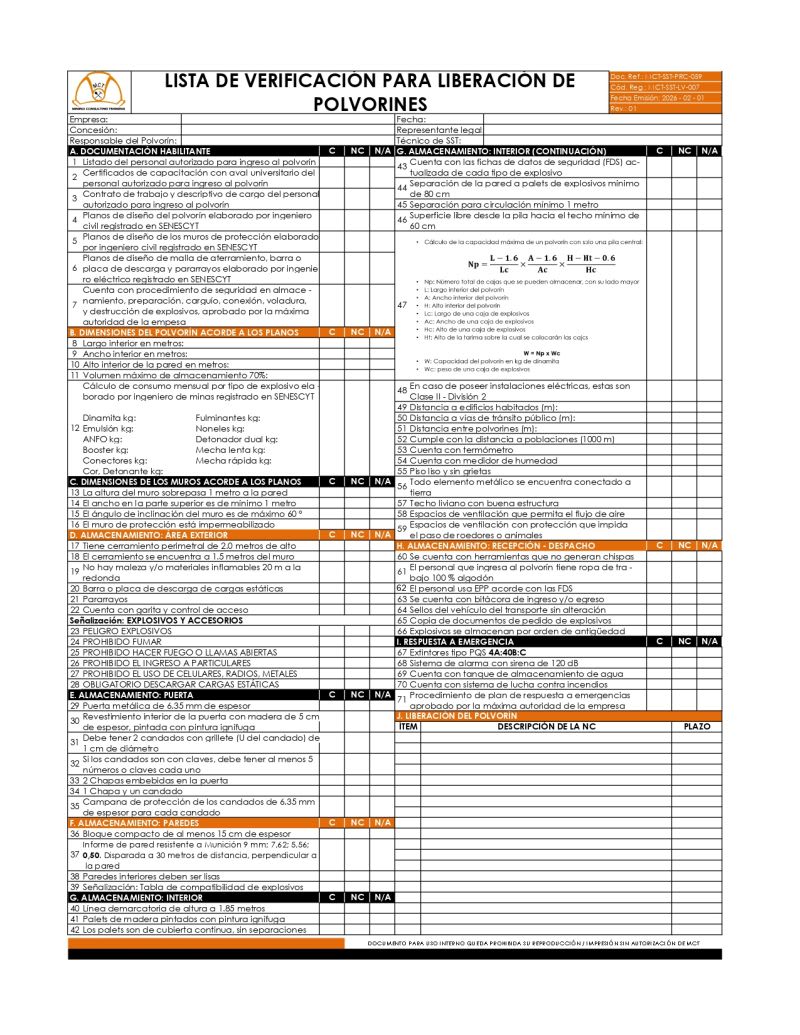
Estandarización técnica para la inspección de polvorines en el sector minero

Compartimos esta Lista de Verificación para la Inspección y/o Liberación de Polvorines como un aporte técnico al sistema de control y fiscalización del almacenamiento de explosivos en minería. Esta herramienta está diseñada para apoyar las inspecciones realizadas por: - Centros de Control de Armas del CCFFAA - Cuerpos de Bomberos del Ecuador - Agencia de Regulación y Control Minero Base normativa y técnica: La lista se fundamenta en la legislación ecuatoriana vigente y en criterios técnicos de la NFPA 495, alineando seguridad industrial, seguridad minera y prevención de eventos mayores. La lista de verificación está estructurada bajo el enfoque FISH: F – Friction (Fricción) I – Impact (Impacto) S – Static (Electricidad estática) H – Heat (Calor) Estos cuatro factores representan los principales mecanismos capaces de iniciar una detonación no deseada y son controlados de manera transversal en todas las etapas del ciclo de los explosivos: - Almacenamiento - Transporte - Preparación y carguío - Conexión y voladura - Eliminación de tiros quedados - Destrucción de explosivos Desde esta perspectiva, la lista no es solo un checklist documental, sino una herramienta de gestión del riesgo, orientada a verificar que el diseño, la construcción y la operación de los polvorines eliminen o controlen las fuentes de Fricción, Impacto, Estática y Calor, reduciendo la probabilidad de detonaciones fortuitas y sus consecuencias. Resultado esperado: - Polvorines con criterios homogéneos de seguridad - Inspecciones más técnicas, objetivas y trazables - Protección efectiva de las personas, las instalaciones y la continuidad operacional En breve compartiremos la Lista de Verificación para el Transporte de Explosivos, completando el enfoque integral de control de riesgos en toda la cadena.

Source: Credit to Byron Andrade
Estandarización técnica para la inspección de polvorines en el sector minero
Like
1
ZVENIA Mining
Corporate at ZVENIA 08/03/2026

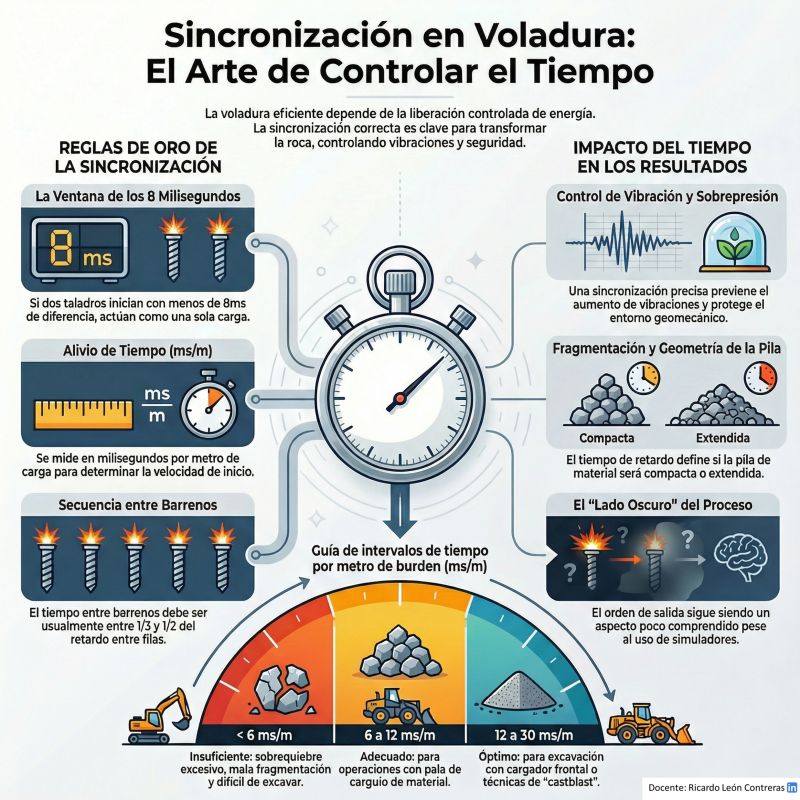
El tiempo lo es todo en voladura... y 8 ms pueden cambiarlo todo

¿Sabías que la sincronización entre taladros determina no solo la fragmentación, sino también la geometría de la pila, las vibraciones y la seguridad de tu operación? Dominar el arte del tiempo en voladura es lo que separa una voladura eficiente de una fuera de control. 🧠 Claves técnicas que debes conocer: ⚡ La Ventana de los 8 Milisegundos Si dos taladros inician con menos de 8 ms de diferencia, actúan como una sola carga. Esto puede amplificar vibraciones y generar sobre rotura. 📏 Alivio de Tiempo (ms/m) Se mide en milisegundos por metro de burden. El intervalo correcto define si la pila será compacta (ideal para palas) o extendida (para cargador frontal o cast blast). 📊 Guía rápida de intervalos: 🔹

Source: Credit to Ricardo León Contreras
El tiempo lo es todo en voladura... y 8 ms pueden cambiarlo todo
Blessing Taiwo
Member 18/12/2025

Case Study: Effect of Stemming Length on Blast Fragmentation – Part 2

Case Study: Effect of Stemming Length on Blast Fragmentation – Part 2 This part of this article evaluates a granite quarry blast introduced in Part 1 of my post (https://lnkd.in/efKgchFt), which consisted of two sections designed with different stemming lengths. The decision to adjust the stemming length was driven by the need for improved confinement, aiming to reduce excessive energy venting and mitigate poor fragmentation caused by energy loss. The first image illustrates the division of the blast: one section with a 1.8 m stemming length and the other with a 2.0 m stemming length. Each blast hole was drilled on a 2.7 m × 2.3 m pattern, and the stemming material used had a D80 size of 22 mm. Results show that while the 2.0 m stemming zone provided better confinement, it produced coarser fragments due to pre-existing geological fractures. These fracture observations and their influence on fragmentation were discussed in detail in the referenced article available here: https://lnkd.in/e7ytv28B The second application of the adjusted stemming length demonstrated both strong confinement and improved fragmentation. WipFrag was used to analyze each section independently, as shown in the attached images. The yellow pocket is the Quarry crusher compatibility, design on WipFrag for this quarry KPI sizes.

Case Study: Effect of Stemming Length on Blast Fragmentation – Part 2
Blessing Taiwo
Member 18/12/2025

Effect of Stemming Length on Blast Fragmentation - Part 1

Effect of Stemming Length on Blast Fragmentation Stemming length plays a critical role in blast performance and the resulting rock fragmentation. The primary function of stemming is to confine explosive gases within the borehole long enough for the shock wave and gas energy to fully act on the surrounding rock mass. When stemming is optimized, more of the explosive energy is transferred into productive breakage rather than being lost as airblast, flyrock, or excessive vibration. 1. Under-Stemming (Too Short) When the stemming column is shorter than required: a. Loss of confinement leads to early venting of gases. b. Reduced energy utilization causes coarser fragmentation. c. Increased airblast and flyrock due to premature blowout. d. Higher variability in fragmentation, making downstream processes less stable. The lack of confinement prevents the explosive from fully fracturing the burden, often resulting in oversized boulders, uneven muckpiles, and inefficiencies in crushing and hauling. 2. Over-Stemming (Too Long) When the stemming column is longer than necessary: a. Energy is overly confined and may not generate adequate heave. b. Fragmentation becomes finer near the collar but may remain coarse at depth. c. Potential for poor throw and tight muckpiles if explosive energy cannot effectively mobilize the rock. d. Over-stemming can create a blast that breaks the collar region well but leaves deeper zones under-fragmented, affecting shovel diggability and crusher feed consistency. Evaluating Stemming Effect Using WipFrag for Continuous Improvement WipFrag offers a practical and data-driven way to assess how changes in stemming length influence fragmentation outcomes across multiple blasts. Because WipFrag is developed by WipWare, the pioneer in image-based fragmentation analysis and a company dedicated exclusively to this discipline, it remains one of the most reliable and trusted technologies available today. When an organization concentrates its expertise on a specific area, much like a ruler designed for a precise purpose, it naturally excels. WipWare’s long-standing focus on fragmentation analysis exemplifies this principle. How WipFrag Helps: Quantify Fragmentation Differences By analyzing muckpile or truck-loading images before and after stemming adjustments, WipFrag provides: Full particle size distribution, bounder count and trend, %fine for each blast, These metrics show whether fragmentation improved or deteriorated following stemming modifications. WipFrag fits perfectly into a Plan–Do–Check–Act process: Plan: Adjust stemming length based on modelling or previous results Do: Implement the blast design Check: Measure fragmentation with WipFrag Act: Refine stemming parameters based on performance This closes the loop and ensures that stemming design evolves with actual site conditions, geology, and production requirements.

Effect of Stemming Length on Blast Fragmentation - Part 1
Blessing Taiwo
Member 18/12/2025

Lessons on the Effect of Fractures on Rock Fragmentation

Lessons on the Effect of Fractures on Rock Fragmentation Rock fragmentation during blasting is strongly influenced by the interaction between stress waves and geological structures. Weak or less stiff zones, such as joints, bedding planes, or other discontinuities, reflect the incoming shock wave during detonation. This reflected energy increases damage on the opposite side of the discontinuity, often producing coarser fragmentation in those areas. Conversely, stronger and stiffer rock units transmit stress waves more efficiently. Blasting produces three primary damage zones within the rock mass: Crushed Zone This forms immediately around the borehole where the explosive shock wave exceeds the rock’s dynamic compressive strength, pulverizing the rock. Fracture Zone As the stress wave travels outward, the rock yields when the induced tensile stresses surpass the dynamic tensile strength. This creates radial and circumferential fractures extending several hole diameters from the blast hole (Ding et al., 2022). Spalling Zone The spalling zone develops when stress waves encounter a free face. The wave reflects back as a tensile wave, and if this reflected tensile stress exceeds the rock’s tensile strength, slabbing or thin “tile-like” breakage occurs (Zhang, 2016). The size and intensity of these zones depend on explosive type, energy characteristics, and rock mass properties. Influence of Geological Structures and Impedance The impedance mismatch between intact rock and geological structures also significantly affects the transmission and distribution of stress waves. When stress waves pass through materials with different densities or stiffness, their speed and amplitude change. This alters fragmentation patterns, influences damage zone extent, and affects material throw. Numerical and Field Evidence Numerical and field studies by Magreth Dotto Ph.D., P.Eng. and Yashar Pourrahimian provide valuable insight into damage distribution in jointed rock masses under blast loading: Their LS-DYNA numerical model for 51 mm holes shows the crushed zone radius extends 87.71 mm, approximately 1.72 times the borehole radius. Using peak particle velocity (PPV) criteria, the fracture zone extends to 3.02 m, or 59.2 times the hole radius. Field trials confirmed these results, with a crushing radius of 93.09 mm and a fracture radius of 3.1 m. PPV measurements showed a significant drop from 102 m/s near the hole to 2.35 m/s beyond the fracture zone indicating the rapid attenuation of energy after fracturing. Key Takeaway for Blasting Engineers A critical lesson from these findings is that the fracture zone generated around each blast hole must remain within the hole’s burden and spacing. If the induced fracture radius exceeds or become lesser than these design parameters, fragmentation becomes inconsistent and inefficient. Understanding the fracture zone radius is essential for designing burden, spacing, and energy distribution that deliver optimal fragmentation.

Lessons on the Effect of Fractures on Rock Fragmentation
Emin Tagiyev
Mining Engineering student at SOCAR 01/11/2025

Hard Rock Blasting - Awesome Mine Blasting Moments

Blast design: How engineers plan hole patterns, depths, and timing to break hard rock efficiently. Fragmentation: How blasting makes rock easier to excavate and transport. Safety: Controlling fly rock, dust, vibration, and ensuring workers stay safe. Mining operations: How blasting impacts productivity and overall mining efficiency.

Emin Tagiyev
Mining Engineering student at SOCAR 01/11/2025

Electronic Detonators

Here’s a more detailed description you can use: This review by M. Cardu explores the significant benefits of **electronic detonators** compared to conventional blasting systems in mining. Electronic detonators provide **exceptionally precise timing**, which allows engineers to control the sequence of explosions more accurately. This precision leads to **better rock fragmentation**, **reduced vibration and airblast**, and overall **safer and more efficient blasting operations**. The paper also explains how these systems improve productivity, lower operational costs, and enhance the predictability of blast results. It’s a valuable resource for understanding modern blasting technology and its role in improving mine safety and performance.

Like
1
jack ilunga
Ingénieur des mines at Kamoa 28/10/2025

Types of TROJAN BOOSTERS in Underground

• 15g Stinger. White coloured, is used in small diameter holes (45mm or less). • 150g booster. Yellow coloured, is in small holes up to 150mm in diameter. • Y-3 booster. Green coloured and conical. Is used to initiate large diameter holes exceeding 150mm in diameter. Mostly at opencast mining operations. • C 400 booster. Red coloured and conical, to initiate large diameter holes exceeding 150mm in diameter. • C 800 booster. Oranger coloured. Is used in deeper blast holes (25m and more).

Types of TROJAN BOOSTERS in Underground
Like
1
Paulo Lopes
Mining Engineer at Beyond Mining 27/10/2025

Microfraturamento induzido pelo desmonte de rochas

[PT]Há quem diga até hoje que a onda de choque produzida pelo demonte de rochas com explosivos não induz danos microestruturais na matriz da rocha, reduzindo portanto, sua resistência mecânica e consequentemente seu pré-requisito energético para cominuição. Provar este fato é mais simples do que parece, e basta medirmos a velocidade de pulso utrassônico das amostras de rochas antes e depois da detonação. Para mais detalhes, confira o post completo aqui na plataforma ZVENIA. [EN] Some people still argue that the shock wave produced by rock blasting with explosives does not induce microstructural damage to the rock matrix, thus reducing its mechanical strength and, consequently, the energy required for comminution. Proving this fact is simpler than it seems; all we need to do is measure the ultrasonic pulse velocity of rock samples before and after detonation. For more details, check out the full post here on the ZVENIA platform. https://zvenia.com/z-posts/estado-de-fraturamento-e-fragmentacao-de-macicos-rochosos-tese-de-doutorado-2020/

Microfraturamento induzido pelo desmonte de rochas
Like
2

Preview of ZVENIA Mining

Sign up to get unlimited content. No credit card needed.

Sign Up Free