Congo, The Democratic Republic of The 2 Zambia 2 Mali 1 Morocco 1 Senegal 1 Australia 1 Indonesia 1 Chile 1 Namibia 1 Venezuela 1 Burkina Faso 1 United States 1
Mining planning should be viewed as a strategic tool for decision-making. From this perspective, the steps or phases to follow are essentially as follows:
1. Clearly define the mining objectives to be achieved;
2. Break these objectives down into specific, time-bound, and quantifiable sub-objectives;
3. Develop and explore various possible options;
4. Conduct a comparative analysis of different options;
5. Evaluate the viability of each option;
6. Perform a financial evaluation of the presented options;
7. Make a provisional selection of the most important option;
8. Analyze and identify the potential negative consequences of this option;
9. Make a final decision.
What challenges do you think strategic mining planning presents?
After nearly thirty years in mining and working across sixteen countries, I keep seeing the same disconnect between Engineering and Production.
Engineers are generally well educated, technically capable people. They build plans that can be extremely detailed and technically impressive. Then those plans are handed to Production Supervisors, many of whom have very different educational and professional backgrounds, and we expect the plan to somehow translate itself into action in the pit.
It rarely does.
I do not think this is about intelligence. I have worked with enough supervisors to know that many of them have excellent practical knowledge and can make decisions in the field that someone sitting in an office might struggle with. The difference is that they are oriented toward execution. They are thinking about what they can see, what they need to dig, what they need to tell the foreman and operators, and what they need to report at the end of the shift.
I think part of the problem is that engineers naturally spend most of their time with other engineers. People tend to build relationships with others who have similar education and ways of thinking. I remember reading The Bell Curve years ago, which discussed some of these differences in education and social groups. Whatever you think of the book, the basic idea made me think about what happens on a mine site.
An engineer who has spent most of his career around other engineers may simply have limited experience communicating with someone who grew up in a kampung in Kalimantan and came into mining through the pit.
So we end up with a forty page plan handed to a supervisor who really needs to know five things.
Where do I dig?
What do I need to produce the plan?
What material am I moving?
Where does it go?
What do you expect me to accomplish today?
Then, at the end of the shift, Engineering needs the other half of the conversation.
This is what you asked us to do.
This is what we actually did.
This is what we did not do.
And this is why.
That is a management system.
The answer is not to dumb down Engineering. Engineering needs to be technically excellent. But technical excellence is only useful if the information can be understood and executed in the field.
A good plan and a usable plan are not necessarily the same thing.
The best plan is not the most detailed plan. It is the plan that gets understood, executed and measured.
Mine planning is always a trade-off.
Push for short-term production…
or protect long-term value?
In reality, both matter.
Too aggressive → risk instability & higher future cost.
Too conservative → lost opportunity.
The challenge is finding the balance.
That’s where real planning happens.
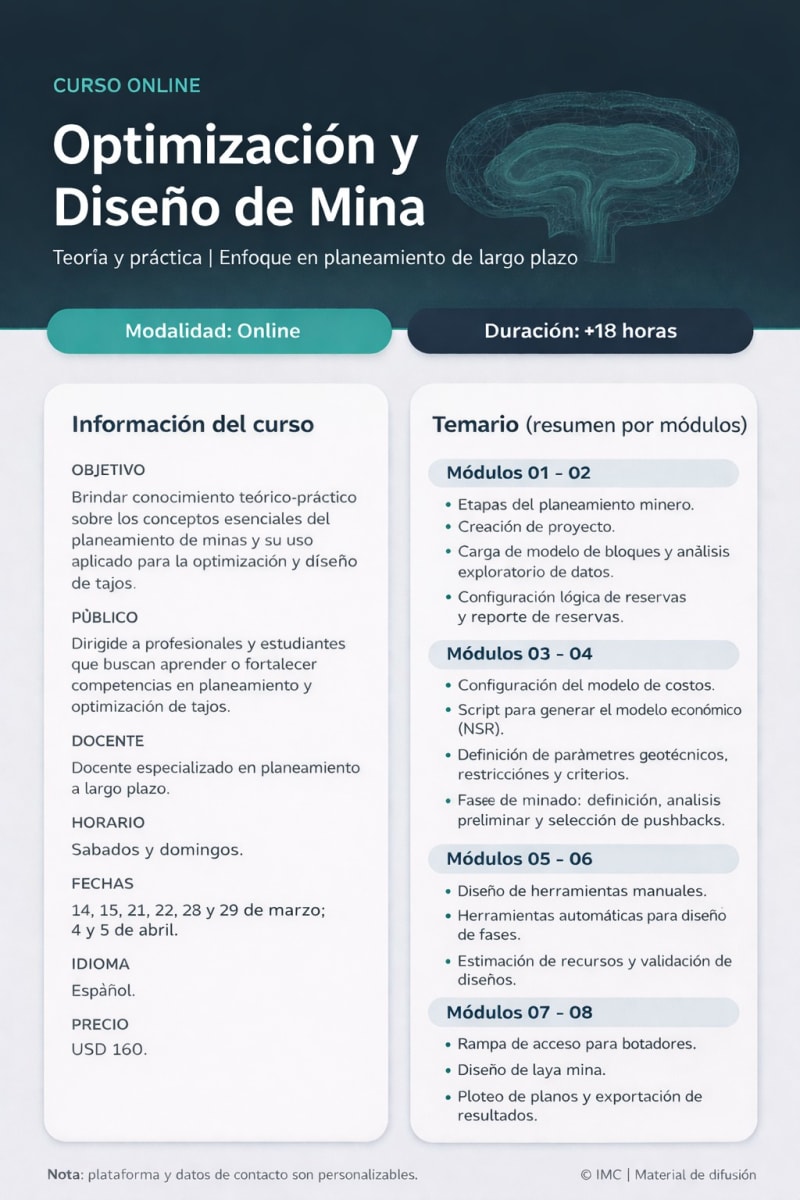
Si quieres Certificarte en PLANIFICACIÓN LARGO PLAZO RAJO con VULCAN, no te pierdas en extra oferta curso online que comienza el 14 de marzo, impartido por un Ingeniero senior experto en programas, por solo 160 USD, o 140.000 pesos chilenos (valor normal 700 USD).
Se entrega CERTIFICADO y PROGRAMA.
El curso tiene una duración de 18 hrs, clases sábados y domingos de 7 a 9 pm horario Chile, y clases grabadas en caso de ausencia.
El curso enseña teoría y práctica con Vulcan, partiendo desde la exploración, pasando por el modelo de recursos, envolvente económica hasta diseño mina y botaderos, y se generan los entregable y ploteos requeridos.
Contacto:
Juan Carlos López Bernal
+56 9 56647098
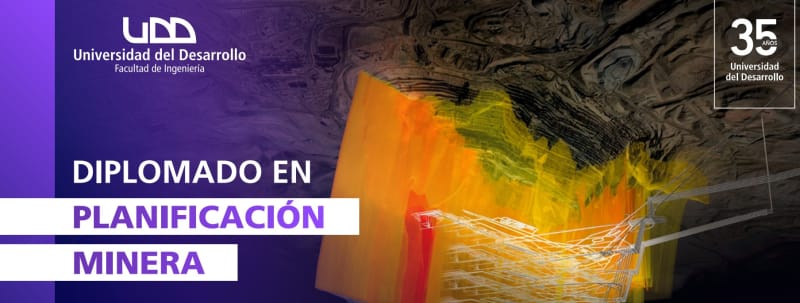
Por pedido de universitarios y colegas en búsqueda laboral, se ofrece en super rebaja curso diplomado de planificación mina más curso básico de vulcan por solo $ 30.000 pesos.
El Diplomado en planificación minera se enseña en 20 horas de videos (38 videos), que explica 3 presentaciones (planificación en general, minería a rajo y minería subterránea).
- Enseña lo esencial para desempeñar el puesto de planificador en una mina, en sus distintos horizontes.
- Enseña los planes mineros reales (LOM, Budget, Forescast, Mensual, Semanal, Diario).
- Explica proceso de planificación desde el Modelos de recursos hasta su Evaluación económica.
- Enseña el diseño minero, operaciones, equipos, geomecánica, secuencia de explotación, para la minería a cielo abierto y subterránea.
- Describe el funcionamiento de los métodos de explotación subterráneos.
- Enseña Información básica a conocer de de otras especialidades en la mineras, - Define conceptos utilizados en planificación.
- Desarrolla algunos ejercicios prácticos (evaluación económica, leyes de corte, etc)
- otros.
El beneficio es capacitar para trabajar en el área de planificación o solo para ser una persona instruida capaz de establecer conversaciones con colegas de cualquier especialidad.
El curso de vulcan es para aprender desde cero y llegar a diseñar minas, y también se enseña con videos. Incluye el programa con licencia.
Este programa es muy utilizado, así que manejarlo es una competencia que sirve en muchos puestos de trabajo.
In large open-pit mining operations, a question comes up quite often:
What matters more for the success of a mine — operations in the field or mine planning?
At first glance the answer seems obvious. Production happens in the pit. Excavators load the material, trucks move it, and operations teams manage the equipment and crews that keep production running.
But mining rarely works like a fixed industrial project.
As the mine advances, geology changes. Stripping conditions vary, water can appear in unexpected places, and ore or coal quality may fluctuate. Because of that, a mine plan is never something that is prepared once and simply followed for years. It constantly evolves as new information comes in.
Operations teams focus on making production happen every day. In a large open-pit with hundreds of equipment units — excavators, haul trucks, dozers and support machines — keeping everything running safely and efficiently is already a major task. Dispatching equipment, managing shifts, maintaining productivity and safety… these are all core operational responsibilities.
Mine planning and technical services, on the other hand, define the framework in which those operations take place.
Planning teams deal with things like pit design, block sequencing, stripping ratios, haul road layouts, production schedules and long-term reserve management. These decisions shape how efficiently the mine will run — and in many cases whether it will remain economically viable over time.
Many of the biggest cost drivers in mining actually come from planning decisions. A slightly longer haul distance can increase fuel consumption significantly. Poor sequencing may lead to unnecessary waste movement. Even small design choices can translate into millions of tonnes of additional material over the life of a mine.
That’s why a phrase you often hear in mining is:
Operations move the material — planning largely determines the economics.
In practice, these two functions represent different layers of responsibility. Operations manage the day-to-day execution, while planning teams focus more on long-term optimization of the resource and the cost structure.
When these two sides work well together, the result is a much more stable and efficient operation.
In many large mining companies such as BHP and Rio Tinto, technical services and mine planning groups play a central role in supporting operational decisions. Geological modeling, production scheduling and cost optimization are all part of the same system.
At the end of the day, the real question is probably not which one is more important.
A mine performs best when strong operations and strong planning support each other.
That balance is what usually separates an average operation from a truly efficient one.
Strategic mine planning is the backbone of a mining feasibility study. It transforms a geological resource into a time‑phased, risk‑aware business plan that supports investment, design, permitting, financing, and closure decisions (Morales et al., 2019; Dowd, Xu and Coward, 2016).
1. Strategic Mine Planning: Definition and Scope
Strategic mine planning is the long‑term, life‑of‑mine (LOM) planning process that determines:
Which part of the resource will be mined (ultimate pit / underground extent)
In what sequence and at what extraction rate material will be mined and processed
With which capacities, configurations, and investments (fleets, plants, infrastructure)
Under what assumptions about markets, costs, technology, environmental and social obligations
For open pits, two core problems dominate (Morales et al., 2019; Dowd, Xu and Coward, 2016):
Ultimate pit limit problem – define the mineable reserve within geotechnical and economic constraints
Life‑of‑mine production scheduling – decide when to extract each block/panel to maximize net present value (NPV) subject to capacity, quality, and other constraints
Strategic planning now extends beyond economic and technical factors to include environmental and closure costs, regulatory frameworks, and sustainability objectives (Oliveros-Sepúlveda, Bascompta-Massanés and Franco-Sepúlveda, 2025).
2. Role and Purpose in a Mining Feasibility Study
At pre‑feasibility and feasibility level, the strategic mine plan is not just a technical deliverable; it is the central integrating element of the study.
2.1 Establishing Technical and Economic Viability
A feasibility study must show that a project is technically feasible and economically worthwhile with an acceptable risk profile. Strategic planning provides (Marković et al., 2025; Morales et al., 2019; Dowd, Xu and Coward, 2016):
Reserves and mine life: conversion of resources into economically mineable reserves, with pit/underground limits and life‑of‑mine horizon
Production profiles: annual or period‑by‑period ore, waste, grades, and product tonnages
Cash‑flow basis: time‑phased revenues, OPEX, CAPEX, sustaining and closure costs feeding NPV and IRR calculations (Marković et al., 2025; Oliveros-Sepúlveda, Bascompta-Massanés and Franco-Sepúlveda, 2025)Hybrid deterministic–stochastic models have demonstrated that deterministic feasibility outputs can be misleading. In a polymetallic open‑pit case, deterministic optimization yielded NPV of USD 130.8 M, while a stochastic model gave a mean NPV of USD 155.5 M with a standard deviation of USD 76.5 M, and revealed a 3 % probability of overall project unprofitability (Marković et al., 2025). This kind of analysis is central to a high‑quality feasibility study.
2.2 Sizing and Phasing Investments and Capacities
Strategic mine plans drive major capital decisions:
Fleet size and timing of acquisitions
Plant capacity and debottlenecking (crushers, mills, concentrators)
Expansion options and their triggers
In a copper open‑pit complex, a multistage stochastic model identified optimal branching investment strategies (truck/shovel fleet changes and a secondary crusher) that increased expected NPV by more than US$170 M compared with a simpler two‑stage approach (Del Castillo and Dimitrakopoulos, 2019). Feasibility studies that ignore such dynamic investment options may under‑ or over‑invest.
2.3 Selecting Mining Options and Configurations
For deposits amenable to both open‑pit (OP) and underground (UG) mining, feasibility studies must determine:
Optimal choice among OP only, UG only, OP→UG, UG→OP, or simultaneous OP+UG
Transition depth/location, crown pillar location, and extraction sequence
Life of mine, strip ratio, blending strategy, and production smoothness as performance indicators (Afum and Ben-Awuah, 2021)A review of surface–underground options highlights the need for integrated (often stochastic) models at the prefeasibility stage to evaluate these configurations with indicators such as NPV, IRR, discounted cash flow, blending ratio, and mine life (Afum and Ben-Awuah, 2021).
2.4 Integrating Environmental, Social, and Closure Considerations
Historically, feasibility‑level planning treated environmental and closure costs as peripheral. Recent work shows these are now core strategic variables (Oliveros-Sepúlveda, Bascompta-Massanés and Franco-Sepúlveda, 2025):
Environmental and closure costs can materially affect NPV/IRR and even reserve definitions (Oliveros-Sepúlveda, Bascompta-Massanés and Franco-Sepúlveda, 2025)- Premature project termination due to environmental or social issues often leads to higher closure costs than planned progressive closure (Oliveros-Sepúlveda, Bascompta-Massanés and Franco-Sepúlveda, 2025)- Sustainable post‑mining land use must be planned strategically using tools such as SWOT and IE matrices, defining strategies for each land‑use option (Amirshenava and Osanloo, 2022)A Peruvian case study showed that integrating an advanced water quality model and closure cost tools into planning enabled ranking mine plans according to long‑term water quality impacts and associated mitigation costs, aligning short‑ and long‑term plans with closure objectives (Sanders and Fitzpatrick, 2022).
2.5 Supporting Project Finance, Permitting, and Social License
Strategic mine plans are used to:
Convince lenders and investors that cash‑flows are robust to key uncertainties (Marković et al., 2025; Del Castillo and Dimitrakopoulos, 2019)- Demonstrate to regulators that waste, water, and closure are planned consistently with legal requirements and policies (Oliveros-Sepúlveda, Bascompta-Massanés and Franco-Sepúlveda, 2025)- Show communities and stakeholders a credible trajectory from construction to closure, including post‑mining land use (Amirshenava and Osanloo, 2022; Sanders and Fitzpatrick, 2022; Oliveros-Sepúlveda, Bascompta-Massanés and Franco-Sepúlveda, 2025)Without a rigorous strategic plan embedded in the feasibility study, these commitments lack quantitative backing.
3. Key Parameters in Strategic Mine Planning
Strategic mine planning uses a large, interdependent set of parameters. At feasibility level, their accuracy, uncertainty characterization, and inter‑dependencies are critical.
3.1 Geological and Geometallurgical Parameters
Block model: The core input is a 3D block model with attributes such as (Morales et al., 2019; Dowd, Xu and Coward, 2016):
Tonnage (volume × density)
Grades of economic and deleterious elements
Lithology, alteration, rock type, structural domains
Geotechnical domains (strength, RMR/Q, joint sets)
Geometallurgical variables – recovery, hardness, comminution specific energy, mineralogy
Traditionally, block attributes are deterministic estimates (e.g., kriging). Modern approaches:
Use equiprobable simulated realizations to represent grade and geometallurgical uncertainty (Morales et al., 2019; Dowd, Xu and Coward, 2016)- Build geometallurgical models capturing spatial variability of recovery, hardness, and comminution energy, sometimes through multiple scenarios (Quelopana et al., 2023; Mata, Nader and Mazzinghy, 2022)Incorporating geometallurgy and its uncertainty can change both pit limits and schedules, with measurable financial impact (Morales et al., 2019; Dowd, Xu and Coward, 2016; Mata, Nader and Mazzinghy, 2022).
3.2 Economic and Market Parameters
Key economic parameters include:
Commodity price forecasts and ranges
Operating costs: mining, processing, G&A, logistics
Capital costs: initial, expansion, sustaining, closure
Discount rate, tax and royalty regimes, exchange rates
Hybrid deterministic–stochastic frameworks characterize these parameters using probability distributions (often via Monte Carlo sampling) instead of single values, explicitly quantifying uncertainty in cash‑flows and NPV (Marković et al., 2025; Sepúlveda, Álvarez and Bedoya, 2020).
3.3 Technical and Design Parameters
Important design and operating constraints include:
Slope design: bench and inter‑ramp angles, controlling pit shape and depth (Morales et al., 2019; Dowd, Xu and Coward, 2016)- Mining capacity: annual total material movement limits, ore mining capacity, waste stripping capacity by equipment and infrastructure (Del Castillo and Dimitrakopoulos, 2019; Morales et al., 2019; Mata, Nader and Mazzinghy, 2022)- Processing capacity: plant throughput, multiple plant streams, down‑time and maintenance patterns, metallurgical plant modes (Quelopana et al., 2023)- Cut‑off grades: fixed or variable cut‑off strategies, often central decision variables influencing reserve size, mine life, and NPV
Stockpiling and blending rules: maximum stockpile capacities, reclaim rates, blending tolerances for grades and contaminants (Del Castillo and Dimitrakopoulos, 2019; Morales et al., 2019; Quelopana et al., 2023)Geomechanical constraints such as haulage ramps, bench widths, minimum mining widths, and controlled strip ratios per period must also be honored; direct block scheduling solutions that ignore these often yield operationally infeasible plans (Morales et al., 2019; Malundamene et al., 2024; Dowd, Xu and Coward, 2016).
3.4 Environmental, Closure, and Sustainability Parameters
Modern strategic planning quantifies:
Environmental costs: waste rock and tailings management, water management, emissions and dust control, ecosystem impacts
Closure costs: backfilling, capping, recontouring, revegetation, long‑term water treatment, monitoring (Amirshenava and Osanloo, 2022; Sanders and Fitzpatrick, 2022; Oliveros-Sepúlveda, Bascompta-Massanés and Franco-Sepúlveda, 2025)- Regulatory and policy frameworks: environmental standards, bonding requirements, SDG‑aligned policies (Oliveros-Sepúlveda, Bascompta-Massanés and Franco-Sepúlveda, 2025)- Post‑mining land use: parameters defining suitability and vulnerability of land‑use options (agriculture, forestry, renewable energy, recreation, etc.) (Amirshenava and Osanloo, 2022)Environmental and closure costs are no longer exogenous; they directly influence resource/reserve reporting and project economics, and must be represented in strategic optimization models (Oliveros-Sepúlveda, Bascompta-Massanés and Franco-Sepúlveda, 2025).
3.5 Energy and Renewable Integration Parameters
With increasing emphasis on decarbonization, strategic planning now includes:
Current and future energy mix (diesel, grid, renewables)
Capital and O&M costs of renewable options (PV, wind, storage)
Carbon pricing or internal shadow carbon values
A SWOT‑based study shows renewable energy adoption in mining can reduce pollution, create jobs, lower operating costs, and enhance circular economy, though hindered by high initial capital and skills gaps (Pouresmaieli et al., 2023). Such parameters need to be reflected in feasibility‑level scenarios.
4. Strategies and Methods for Optimizing the Mine Plan
Optimization methods have evolved from simple deterministic pit shells to comprehensive stochastic and adaptive frameworks.
4.1 Deterministic Optimization: Baseline Practice
At feasibility, most projects still rely on a deterministic optimization chain:
Pit optimization:
Lerchs–Grossmann or equivalent network‑flow algorithms compute ultimate pit shells to maximize undiscounted or discounted profit subject to slope constraints (Anisimov, Bariatska and Cherniaiev, 2024; Morales et al., 2019).
Modern software (e.g., Geovia Whittle) generates multiple nested pit shells under varying economic parameters, aiding selection of a final shell even for complex, multi‑ore‑body geometries.
Phase (pushback) design:
Intermediate pit shells define stages for operational practicability, controlling working widths, access, and strip ratios over time (Anisimov, Bariatska and Cherniaiev, 2024).
LOM scheduling:
Linear / mixed‑integer programming (MIP) or heuristic algorithms schedule blocks/panels over periods, maximizing NPV under capacity, precedence, and blending constraints (Morales et al., 2019; Dowd, Xu and Coward, 2016).
Cut‑off grade and stockpiling policies:
Often parametrically optimized (e.g., through nested LPs or heuristics) to maximize NPV while meeting product quality and capacity targets.
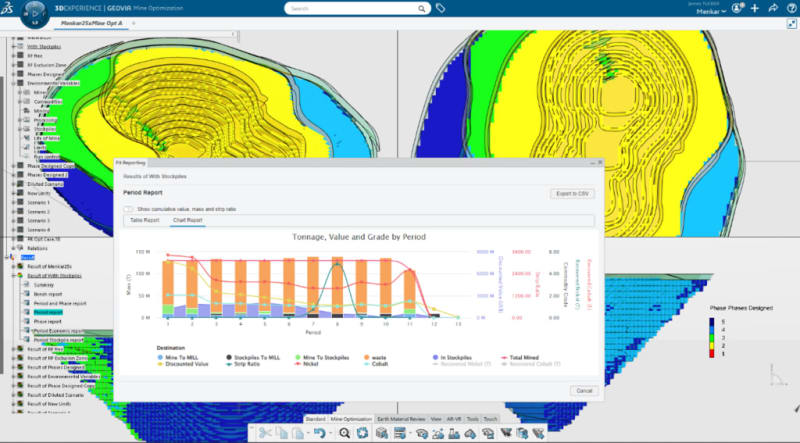
NPV Pit Optimization
Figure 1: NPV Pit Optimization
Deterministic optimization is computationally efficient and embedded in commercial packages. However, it presumes single‑value inputs and does not quantify risk, leading to potentially misleading “optimal” plans (Marković et al., 2025; Fernanda et al., 2024; Sepúlveda, Álvarez and Bedoya, 2020).
4.2 Stochastic Optimization and Risk‑Based Strategic Planning
Stochastic optimization explicitly addresses geological, technical, and market uncertainty.
4.2.1 Hybrid Deterministic–Stochastic Models with ISO 31000
A hybrid model integrates:
Deterministic optimization (base case pit limit and schedule)
Stochastic optimization over distributions of key parameters (prices, costs, ore grades)
Risk analysis structured by ISO 31000 risk management principles (Marković et al., 2025)Monte Carlo simulation generates distributions for input parameters; these feed a stochastic optimizer that produces NPV distributions, not just a single value. In the cited case, VaR and CVaR show a 3 % probability of project unprofitability despite positive mean NPV, revealing downside risk masked by the deterministic case (Marković et al., 2025).
This supports feasibility‑level decision‑making by:
Quantifying downside NPV at chosen confidence levels (e.g., 95 % VaR)
Identifying parameters that most drive risk
Designing more robust pit limits and schedules
4.2.2 Multistage Stochastic Programming for Mining Complexes
Mining complexes with multiple pits and processing streams face dynamic investment and configuration decisions:
Changing fleets, adding crushers, modifying plant capacities
Routing ore among multiple plants and stockpiles
A multistage stochastic programming model:
Uses a scenario tree with multiple recourse stages
Makes sequential investment and operating decisions based on observed information in each period
Embeds capital investment variables that activate capacities and costs when chosen
In a copper complex, this approach generated a dynamic strategic plan with branching options for configurations; expected NPV increased by more than US$170 M relative to a two‑stage model, and the solution showed a substantial probability that the mine design should branch rather than follow a single fixed path (Del Castillo and Dimitrakopoulos, 2019).
Adaptive simultaneous stochastic optimization at the Escondida complex likewise used geological simulations and branching plans to produce operationally feasible strategies that adapt to uncertainty, improving value and risk positioning (Fernanda et al., 2024).
4.2.3 Metaheuristics and Simulation‑Based Stochastic Planning
Where exact MIP formulations become intractable, metaheuristic algorithms (variable neighbourhood descent, simulated annealing, evolutionary algorithms) combined with simulation are employed (Sepúlveda, Álvarez and Bedoya, 2020; Quelopana et al., 2023):
These methods search large solution spaces for near‑optimal LOM schedules under multiple scenarios.
Stochastic open‑pit planning models can include grade and price uncertainty and produce robust schedules that maximize expected profit and mitigate risk (Sepúlveda, Álvarez and Bedoya, 2020).
Research suggests that including additional variables (environmental, social) into these stochastic frameworks would further improve realism (Sepúlveda, Álvarez and Bedoya, 2020).
4.3 Integration of Geometallurgy and Plant Operation
Long‑term planning that ignores geometallurgy can under‑ or over‑estimate project value.
4.3.1 Geometallurgical Scenarios in Pit Limits and Scheduling
A risk‑aware geometallurgical approach (Morales et al., 2019; Dowd, Xu and Coward, 2016):
Builds multiple equiprobable scenarios of grades and geometallurgical attributes (recovery, hardness, etc.).
Performs pit optimization per scenario, then defines a reliability pit that is feasible across scenarios.
Uses stochastic integer programming to schedule blocks from the reliability pit, maximizing expected discounted value and minimizing deviations from production targets (Morales et al., 2019).
Results show that including geometallurgical uncertainty can materially change optimal pit depth, pushbacks, and extraction sequences, thus affecting NPV and risk (Morales et al., 2019; Dowd, Xu and Coward, 2016).
4.3.2 Detailed Plant Modes within Strategic Optimization
To bridge mine and plant optimization, geometallurgical detailing of plant operation has been introduced (Quelopana et al., 2023):
The strategic algorithm is adapted (via Dantzig–Wolfe decomposition) to include plant operational modes (e.g., different comminution circuits) as linear sub‑problems.
For each geological scenario, the model chooses not only which blocks to mine and when, but also how to process them (mode selection) (Quelopana et al., 2023).
Case calculations based on the Mount Isa deposit show that a plant upgrade can significantly reduce mining equipment requirements without materially affecting NPV, demonstrating that strategic integration of plant modes can change investment and scheduling decisions (Quelopana et al., 2023).
4.3.3 Comminution Specific Energy and Global Optimization
Global optimization that integrates geometallurgical variables such as comminution specific energy into pit, pushbacks, and scheduling steps can yield (Mata, Nader and Mazzinghy, 2022):
~9.7 % increase in NPV and ~5.2 % increase in ore production versus simpler strategies
More stable strip ratios and better control of comminution energy over time
This underscores the value of including such variables in block models and optimization objectives at feasibility stage (Mata, Nader and Mazzinghy, 2022).
4.4 Real Options and Strategic Flexibility
Real options treat certain strategic decisions as options rather than fixed commitments.
At project level, options include delaying development, staging expansions, scaling capacity, or abandoning (Ali and Rafique, 2024).
At planning level, “planning options” include extraction sequences, cut‑off policies, slope modifications, and capacity switches (Ali and Rafique, 2024).
Real options:
Transform uncertainty into opportunity by allowing adaptive responses to market and geological changes (Ali and Rafique, 2024).
Complement stochastic optimization: while stochastic models produce adaptive plans, real‑options valuation quantifies the value of such flexibility.
The literature highlights that naïve single‑scenario optimization ignores this adaptive capability, whereas flexible designs can reconfigure in response to new information, better matching actual operating conditions (Ali and Rafique, 2024; Fernanda et al., 2024).
4.5 Multi‑Criteria and Sustainability‑Oriented Strategies
Economic objectives (NPV, IRR) increasingly share space with:
Resource utilization (rational depletion, recovery)
Environmental impact and closure cost
Social criteria (employment, community impacts)
A multi‑criteria optimization applied to an underground coal mine combined geological constraints, infrastructure, and economic metrics (NPV, EBIT, FCFF). Millions of scenarios were screened digitally, revealing many better scenarios than the base case; the best scenario had NPV ~50 % higher than the base case, which ranked only 52nd of 60 (Kopacz et al., 2020).
State‑of‑the‑art reviews emphasize operations research methods (LP, dynamic programming, stochastic programming, metaheuristics) as key tools to design sustainable surface mine plans aligned with SDGs (Pouresmaieli et al., 2023; Oliveros-Sepúlveda, Bascompta-Massanés and Franco-Sepúlveda, 2025).
Key Parameters and Optimization Approaches in Strategic Planning
Planning Focus Main Parameters / Decisions Dominant Methods
Pit limits & reserves Block values, slope design, geotechnical domains Lerchs–Grossmann, network flow, global optimization in software (e.g., Geovia Whittle)
LOM scheduling Block/panel sequencing, capacities, cut‑offs, stockpiles LP/MIP, stochastic integer programming, metaheuristics
Mining complexes & investments Fleet, crushers, plant capacities, configuration branches Multistage stochastic programming, adaptive branching
Geometallurgy & plant modes Recovery, hardness, comminution energy, plant modes Scenario‑based geomet models, Dantzig–Wolfe, global optimization
Risk & uncertainty Prices, costs, grades, geomet, env. costs Hybrid deterministic–stochastic with Monte Carlo, VaR/CVaR, ISO 31000
Sustainability & closure Env./closure costs, PMLU options, energy mix Quantitative closure costing models, SWOT/IE, SDG‑aligned planning
Figure 2: Core decision areas and optimization tools in strategic mine planning.
5. Risks and Potential Losses from Suboptimal Strategic Mine Plans
Suboptimal or naïve strategic mine plans can cause large economic, environmental, and social losses.
5.1 Economic and Financial Risks
5.1.1 Misleading Economic Evaluation and NPV Overestimation
Deterministic models that neglect uncertainty can substantially mis‑estimate project value and risk.
In the hybrid risk‑based study, deterministic NPV was USD 130.8 M, but stochastic modelling showed mean NPV of 155.5 M with σ = 76.5 M and a non‑trivial (3 %) probability of project unprofitability (Marković et al., 2025). A feasibility study relying on the single deterministic number would understate downside risk.
Stochastic optimization reviews emphasize that deterministic planning tools maximize profit under unrealistic assumptions and do not value risk appropriately (Sepúlveda, Álvarez and Bedoya, 2020).
Investors and lenders may commit capital to projects whose downside risk is much higher than indicated by deterministic feasibility models.
5.1.2 Lost Value from Non‑Optimized Schedules
The coal mine multi‑criteria optimization shows directly the cost of suboptimal plans:
The “base case” schedule actually implemented ranked 52nd of 60 generated scenarios.
The best scenario achieved NPV nearly 50 % higher than base case, with only small differences (
A short post to remind mine planning engineers that grade is just a proxy for value. You need to prove to yourself that it is a good proxy to use.
Years ago, I used to present a value creation and #CutOffGrade seminar. I would start the seminar with the following three questions as a thinking exercise:
Q1: Consider two blocks of ore (everything else being equal), which block has higher value:
(a) 100 tonnes @ 2.0% Cu.
(b) 100 tonnes @ 2.5% Cu.
The obvious answer would be (b), as it contains 2.5 tonnes of copper, versus (a) with 2.0 tonnes of contained copper
Q2: Consider the same two blocks of ore, but now with recovery information (and again everything else being equal), which block has higher value::
(a) 100 tonnes @ 2.0% Cu - with 80% recovery.
(b) 100 tonnes @ 2.5% Cu – with 85% recovery.
Again, the obvious answer would be (b), as it has 2.1 tonnes of recovered copper versus (a) with 1.6 tonnes of recovered copper.
Q3: Now consider the same two blocks of ore, with recovery information and throughput information (and again everything else being equal), which block has higher value:
(a) 100 tonnes @ 2.0% Cu - with 80% recovery, and SAG mill throughput of 100 tph (so soft ore, and/ore well fragmented).
(b) 100 tonnes @ 2.5% Cu – with 85% recovery, and SAG mill throughput of 70 tph (so hard ore, and/or poorly fragmented).
Now, the answer flips to (a), as (a) has a recovered copper per hour ‘value’ of 1.6 tonnes Cu per hour, and (b) has a ‘value’ of 1.49 tonnes Cu per hour.
So, in this third situation, the lower grade, lower recovery ore provides 7% greater ‘value’ in time – and it is what we produce in time that ultimately determines the value (NPV is after-all a measure of ‘$s in time’).
This leads to the ‘cash flow grade’ concept, quite well described by Dr Brett King in a paper he write back in 1999. (I loved this paper when I first read it, as I was ~90% there myself - and felt frustration that Brett had written it first!) The concept also leads to the necessary identification of system bottlenecks that need to be exploited (#TheoryOfConstraints) to increase the ‘value flow’.
These concepts are effectively what Gerald Whittle has effectively based his business on: the cash flow grade concept – combined with TOC – and using software to solve complex systems that can result.
So – grade is just a proxy for value. Sometimes it can be a good proxy. Other times it can be a poor proxy.
I have only ever once seen a feasibility study use a cash flow grade for the mine schedule. And I will be first to acknowledge it is not an easy thing to use. It can’t be directly measured like a grade. It must be calculated from multiple factors – of which grade is just one factor. And we usually often don’t have reliable models for those other relevant factors.
My advice: do as much economic value modelling of your ore value as you can, and find some approach to cut-off value that is practical and makes sense, AND captures some of that time value.
References
King, B. 1999, “Cash Flow Grades - Scheduling Rocks with Different Throughput Characteristics”, Proc. Conf. Optimising with Whittle, Perth 1999.
Figure 1 shows a short-term execution plan: a task-level schedule by block with a matching Gantt chart for activities like block prep, drilling, blasting, and loading/hauling across specific dates and per cent complete. This is the actionable weekly plan that converts quarterly intentions into sequenced tasks, revealing whether upstream quarterly sequencing is feasible once real equipment hours, benches, and inter block dependencies are honoured.
Figure 1: Block Sequencing
Why sequencing matters now
• The order of drilling–blasting–hauling across blocks determines whether access to the next ore block opens on time, directly affecting short-term cash flow and NPV contributions of the quarter. If drilling slips on the lead block, blasting and ore exposure slip, starving the plant and eroding NPV.
• Short-term plans must respect pit precedence, geotechnical widths, and fleet capacity; the table’s “days complete/remaining” and “per cent complete” columns are the control points to keep exposed ore ahead of the shovel, preventing production delays.
Sustainable ore access in weekly plans
• Use the execution plan to enforce a minimum “exposed ore” buffer: ensure each ore block’s loading window begins only after preceding waste and prep tasks clear access, and maintain a rolling stock/exposure KPI for the next 1–2 weeks. This operationally enforces the “minimum exposed ore" concept.
• Sequence pushbacks so that waste removal tasks in the Gantt precede high-grade ore starts by several days, keeping pit geometry regular and avoiding re handles; this short-term discipline is what sustains long-term access.
Leveraging market conditions
• When prices are high, front-load high-grade blocks in the near-term chart by accelerating drilling and blasting earlier and allocating more shovel hours, while shifting some low-grade or waste to night shifts or subsequent weeks; when prices weaken, delay lower-margin ore or feed from stockpiles. This dynamic cutoff and rate adjustment enhance quarter NPV.
• Scenario test the next four weeks against price bands: re-sequence blocks and update the Gantt to schedule capital-intensive moves (e.g., additional shovel or contractor drill) only in favourable windows. Adaptive plans can outperform static ones significantly.
How the figure should be used
• Validate quarterly plan: if the Gantt shows overlapping haul or drill windows causing resource conflicts, it is an early signal that the quarterly sequencing was unrealistic; fix at the execution plan first because this is where actions occur.
• Maintain leading indicators: track “per cent complete” on critical path blocks and a daily “days of exposed ore ahead” metric; if exposure drops below target, reassign drills or add a blast to protect mill feed continuity.
Where to invest effort
• Prioritise execution scheduling quality: tighten activity durations, resource calendars, and inter-block links so the plan is feasible and resilient; poor execution plans translate directly to downtime and lost margin.
• Build a rolling 4–6 week look ahead tied to quarterly milestones: the weekly Gantt is updated daily, but always anchored to opening the next pushback’s ore blocks on time to preserve sustainable access and market timing benefits
1
15 Planning
Focuses on short-, medium-, and long-term mine planning and scenario analysis.
Planning courses and strategic mine planning workshops.