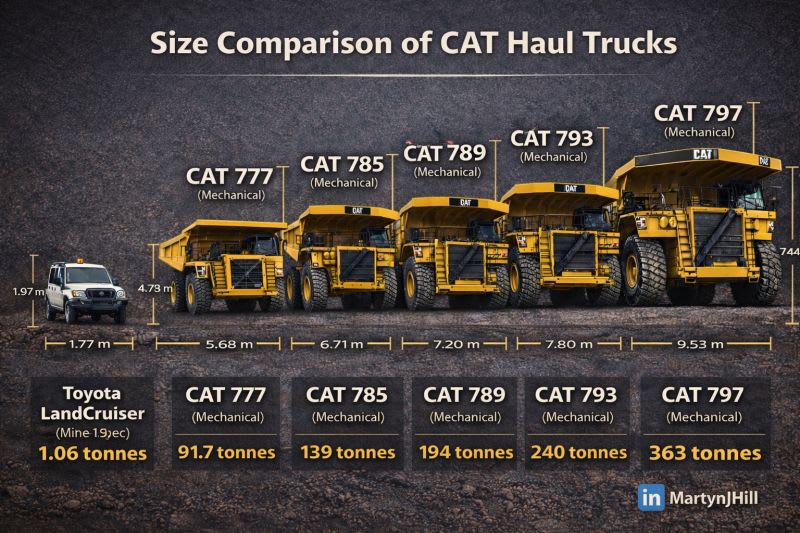
Not all haul trucks are created equal
This side-by-side comparison shows just how quickly mining equipment scales, and why lumping machines together misses the reality of modern operations. A mine-spec Toyota LandCruiser is designed for mobility, inspections, and supervision. It weighs just over a tonne and operates in a low-consequence environment. Step into a CAT 777 and you are already dealing with a 90-plus tonne machine where braking distance, payload discipline, and ground conditions matter. Move up through the 785, 789 and 793 classes and each jump brings exponential increases in size, energy, tyre loads, maintenance complexity, and safety exposure. By the time you reach the ultra-class CAT 797, you are in a completely different operating category. At more than 360 tonnes, this truck does not simply service a mine, it defines it. Haul roads, pit geometry, maintenance workshops, fuel systems, and training frameworks are all engineered around equipment of this scale. This is why ultra-class fleets are typically found at tier-one operations run by miners such as BHP, Rio Tinto, Fortescue, Newmont and Vale. These machines only make sense where ore bodies are large, mine lives are long, and operational discipline is non-negotiable. The takeaway is simple. As equipment scales, so do the operating environments around it. Light vehicles, mid-class haul trucks and ultra-class fleets sit on a continuum of size, consequence and complexity, each requiring different levels of planning, support and experience. Scale does not change the fundamentals of mining, but it significantly changes how they must be managed.