The Right Site Investigation Terminologies
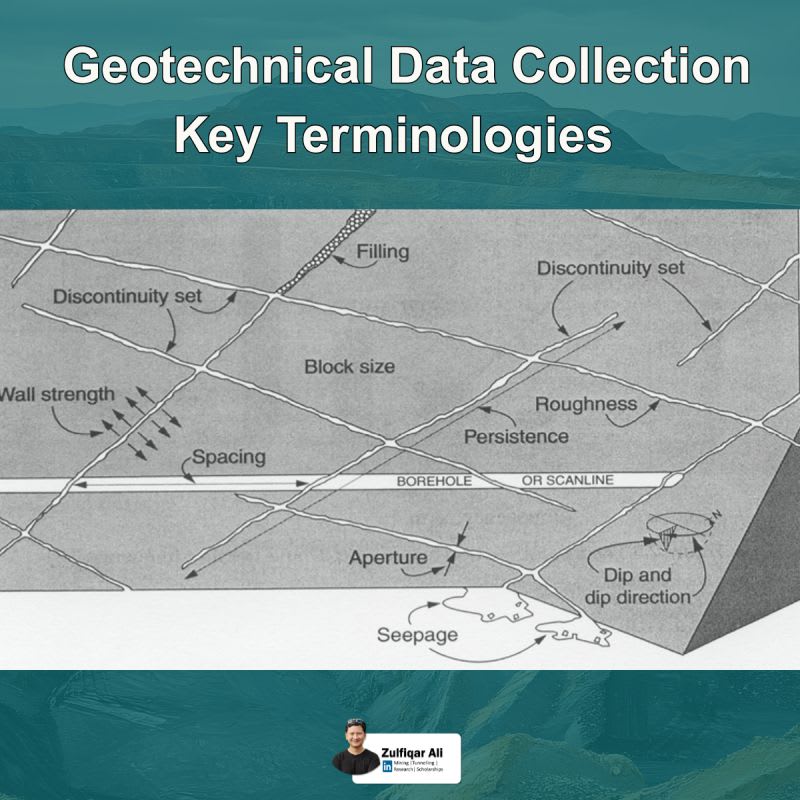
During site investigation, these are the key terminologies that must be logged accurately. 1️⃣ Discontinuity Set Group of joints/faults with similar orientation. Identified via structural mapping and stereonet analysis. 2️⃣ Dip & Dip Direction Orientation of the plane (e.g., 45°/120°). Critical for kinematic analysis in slopes and tunnels. 3️⃣ Spacing Perpendicular distance between joints of the same set. Controls block size and deformability. 4️⃣ Persistence Trace length/continuity of a joint. High persistence = higher large-scale failure potential. 5️⃣ Roughness Surface texture (smooth to very rough). Governs shear strength and dilation (linked to JRC). 6️⃣ Aperture Opening between joint walls. Influences permeability and deformability. 7️⃣ Filling (Infill Material) Clay, calcite, gouge, etc. Often reduces shear strength dramatically. 8️⃣ Seepage Groundwater condition (dry to flowing). Directly affects effective stress and stability. 9️⃣ Wall Strength Strength of intact rock forming joint surfaces. Assessed via hammer tests or point load index. 🔟 Block Size Result of joint spacing and orientation. Controls stand-up time and support requirements.