Open-Pit Mining Terminologies
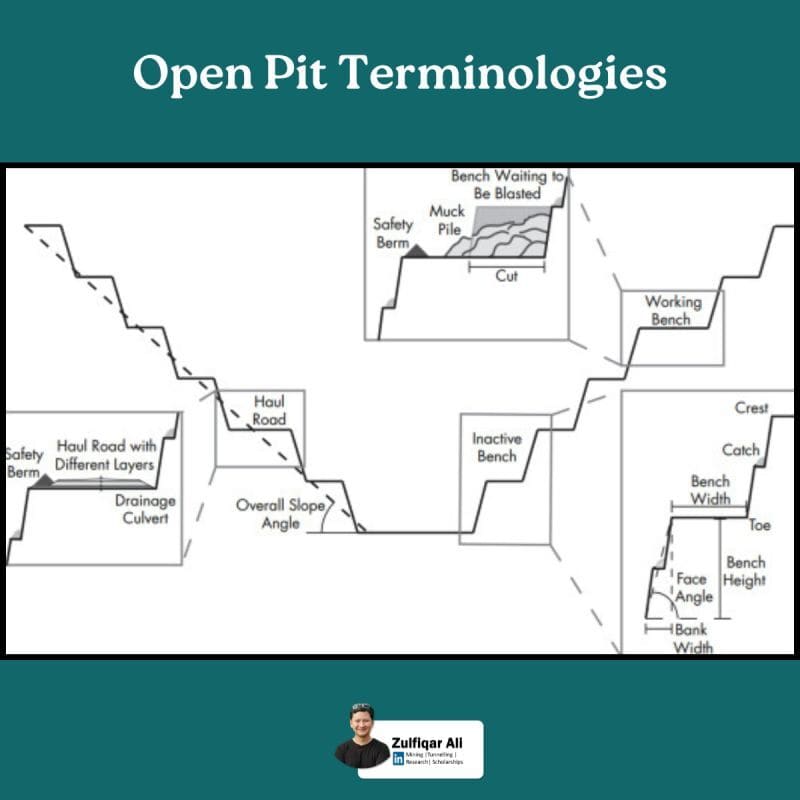
Fundamental Pit Geometry ▪ Pit: The large, terraced excavation created to extract ore from near-surface deposits. ▪ Bench: A horizontal step cut into the pit, formed during mining to provide stability and access. ▪ Berm: A safety strip or horizontal shelf left between benches to catch falling rocks and support stability. ▪ Batter: The sloping surface of a bench wall. ▪ Batter Angle: The angle of inclination of the bench wall, measured from the horizontal. ▪ Face: The active rock surface where drilling, blasting, and loading occur. ▪ Crest: The top edge of a bench or slope. ▪ Toe: The bottom point where the bench slope meets the horizontal floor. ▪ Inter-Ramp Angle (IRA): The angle formed by a stack of benches without considering the berms at every level. ▪ Overall Angle: The final stable slope angle from pit crest to pit bottom, accounting for all benches and berms. Mining Operations & Equipment ▪ Pit Stages: Sequential mining phases that advance the pit outward and downward in planned steps. ▪ Loading: The process of picking up blasted rock using machinery such as shovels, excavators, or loaders. ▪ Hauling: Transporting ore or waste rock from the pit to dumps, crushers, or stockpiles using haul trucks. ▪ Haul Road: Engineered roads designed within the pit for the safe movement of heavy machinery. ▪ Shovel / Excavator: Primary loading equipment used to dig and load blasted rock. ▪ Front-End Loader: A versatile machine used for loading, stockpiling, and short-distance material movement. ▪ Dump: A designated area where waste rock is deposited. ▪ ROM (Run of Mine): Material delivered directly from the mine to the processing plant without any pre-crushing. ▪ Drilling: The creation of blast holes for explosives. ▪ Blasting: Fragmentation of rock using explosives to allow efficient excavation.