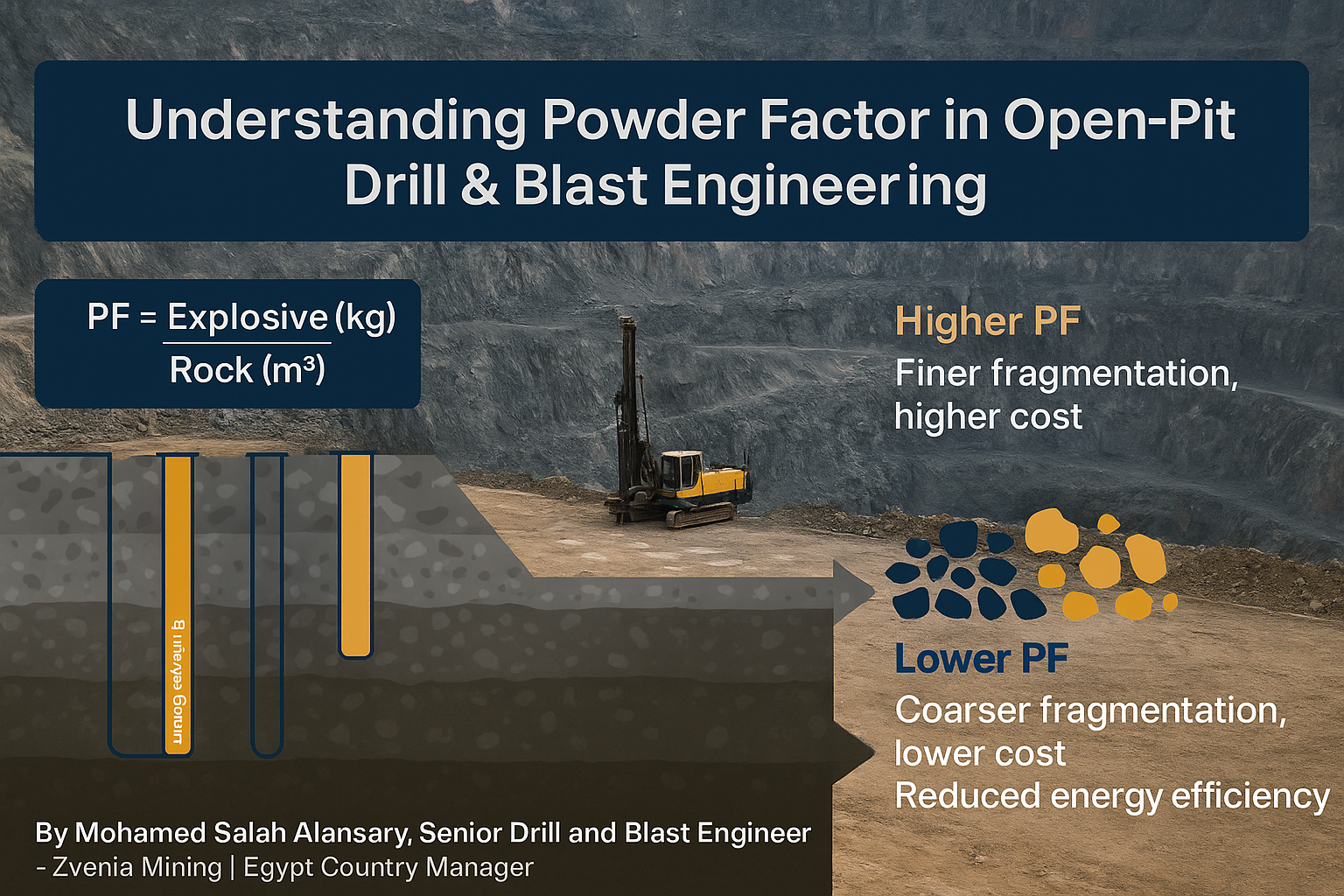
The Power of Powder Factor
Understanding Powder Factor in Open-Pit Blasting Engineering By Mohamed Salah Alansary Senior Drill & Blast Engineer – Zvenia Mining | Egypt Country Manager ________________________________________________________________________________________________________________ Introduction Powder Factor (PF) is one of the fundamental parameters in drill and blast engineering. It defines the ratio between the mass of explosives used and the volume or mass of rock blasted. Despite being a simple ratio, Powder Factor governs the overall performance of blasting operations and directly impacts productivity, cost efficiency, and downstream processes across the mine site. ________________________________________________________________________________________________________________ Definition Powder Factor is expressed as: PF = Explosive (kg) / Rock (m³) or PF = Explosive (kg) / Rock (tonne) This ratio indicates the quantity of explosive energy applied per unit of rock. The primary objective is to match the explosive energy to the rock’s resistance, ensuring effective fragmentation without excessive energy consumption. ________________________________________________________________________________________________________________ Purpose The purpose of optimizing Powder Factor is to achieve efficient energy utilization during rock breakage. The correct PF results in uniform fragmentation, optimized shovel loading, efficient crusher performance, and reduced operational costs. Conversely, incorrect Powder Factor values may cause poor fragmentation, high boulder generation, excessive vibration, or unnecessary explosive consumption. ________________________________________________________________________________________________________________ Operational Impact Powder Factor influences several key operational aspects: Fragmentation: Determines particle size distribution, influencing loading, hauling, and crushing efficiency. Drill and Blast Cost: Controls the balance between explosive consumption and fragmentation quality. Productivity: Affects the loading rate, cycle time, and overall mine output. Environmental Control: Impacts vibration levels, flyrock, and airblast management. A well-optimized PF provides a balance between fragmentation quality, cost, and environmental control. ________________________________________________________________________________________________________________ Typical Ranges Powder Factor varies based on rock hardness and geological conditions. The following ranges are generally accepted as guidelines: Rock Type Typical PF (kg/m³) Soft Rock 0.3 – 0.6 Medium-Hard Rock 0.6 – 0.9 Hard Rock 0.9 – 1.2 These values serve as reference points. Actual PF selection should be determined through on site trials, monitoring, and data driven analysis. ________________________________________________________________________________________________________________ Advanced Considerations At an advanced level, Powder Factor is linked to blast energy distribution, burden and spacing design, and overall blast efficiency. Modern software tools allow engineers to simulate PF adjustments and predict outcomes before field implementation. Engineers should consider the Powder Factor as part of an integrated system that includes hole diameter, bench height, subdrill, stemming length, and explosive type. Proper evaluation ensures consistency between design intent and actual blast results. ________________________________________________________________________________________________________________ Practical Insights In general: -Higher PF tends to produce finer fragmentation but increases explosive costs. -Lower PF typically results in coarser fragmentation, reduced energy efficiency, and may increase secondary breakage requirements. The optimal value lies between these extremes, depending on operational goals, rock type, and downstream constraints. ________________________________________________________________________________________________________________ Conclusion Powder Factor remains a key indicator of blast performance and a vital control parameter in open-pit mining. It is not a fixed value but a dynamic variable that must be adjusted based on actual ground conditions, geology, and operational targets. Ultimately, achieving an effective Powder Factor requires technical understanding, continuous monitoring, and practical experience.