Small Index but BIgger Impact
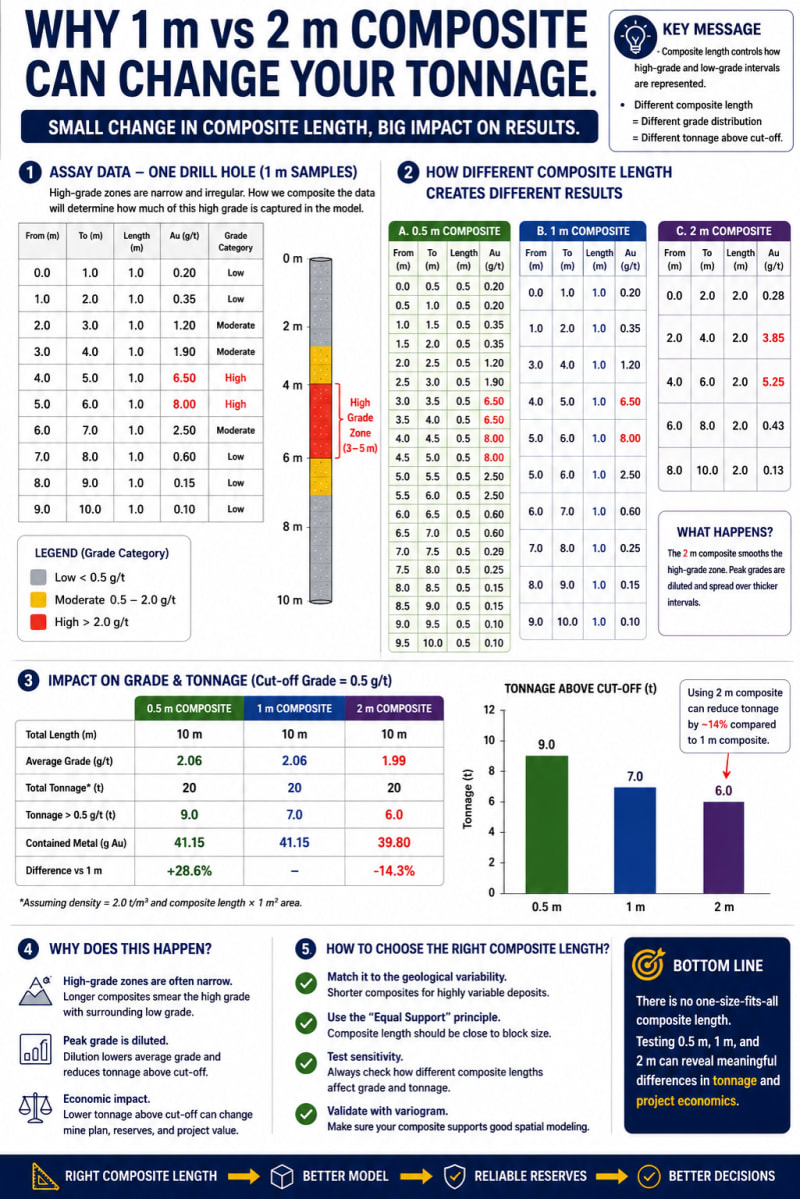
WHY 1 m vs 2 m COMPOSITE CAN CHANGE YOUR TONNAGE In reserve estimation, compositing is not just a data preparation step — it directly influences how geology is represented inside the model. Using the same assay dataset, different composite lengths (0.5 m, 1 m, and 2 m) can produce different outcomes. Shorter composites may preserve narrow high-grade intervals and geological variability. Longer composites tend to smooth grades, dilute local peaks, and redistribute metal across thicker intervals. As a result: • Average grade can shift • Tonnage above the cut-off can increase or decrease • Contained metal changes • Economic decisions may be affected There is no universal “best composite length.” The right approach should consider: ✔ Geological continuity ✔ Sample support consistency ✔ Variogram behavior ✔ Selective Mining Unit (SMU) ✔ Block model resolution ✔ Sensitivity testing Reserve estimation is not only about estimating blocks.It starts from how we choose to represent the original assay data. Composite smarter → Model better → Estimate with confidence. #ReserveEstimation #Mining #Geology #ResourceModeling #OreReserve #BlockModel #Compositing #Geostatistics #MiningEngineering #MineralResources #GeologicalModeling #MiningConsultant #NickelMining #MinePlanning #Zvenia