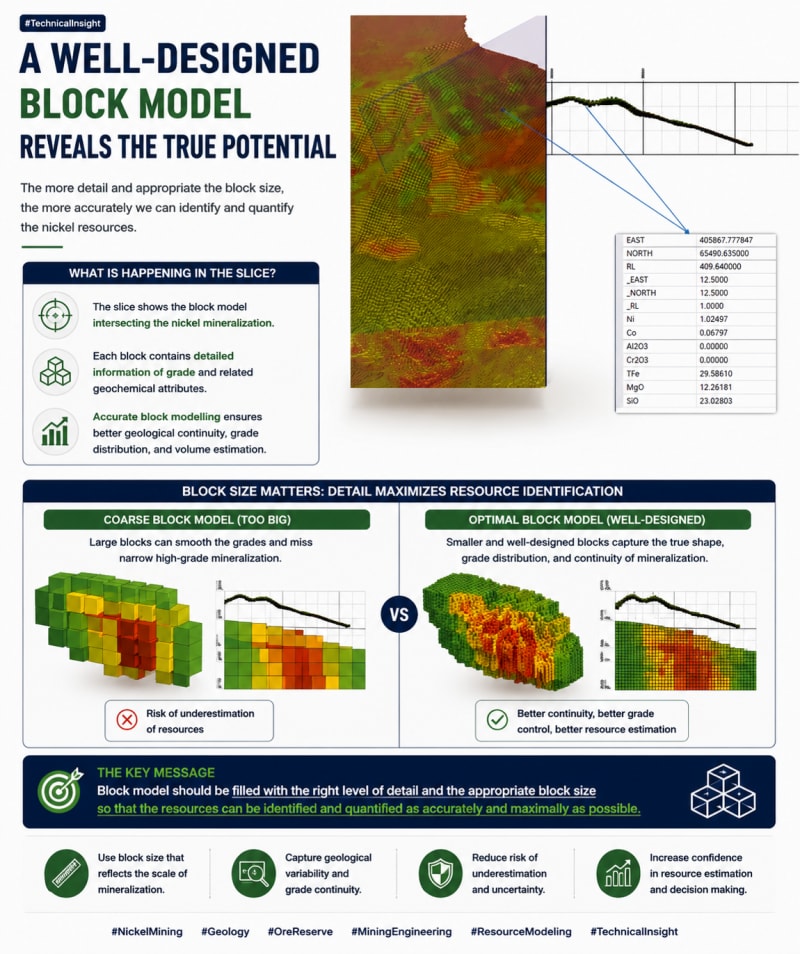
Small Details Unlock The True Potential of Reserve Estimation
A well-designed block model is one of the most important foundations in nickel resource estimation. In lateritic nickel deposits, mineralization can change rapidly both laterally and vertically. Because of this, block size and model detail play a critical role in how accurately the resource can be identified and quantified. If the block model is too coarse, important geological variability and narrow high-grade zones may be smoothed or even missed entirely. On the other hand, a properly designed block model with appropriate block dimensions allows us to better capture: 1. grade continuity, 2. geological boundaries, 3. mineralization trends, 4. and the true geometry of the orebody. The slicing section shown here represents how actual field data is translated into a detailed block model using real nickel data. Each block carries geological and geochemical information that contributes to the final resource estimation. At the end of the day, resource modeling is not simply about filling blocks inside software — it is about understanding how detailed the model should be so the resources can be identified as accurately and maximally as possible. “A good block model does not only visualize the deposit — it reveals its true potential.” #NickelMining #Geology #OreReserve #MiningEngineering #ResourceModeling #BlockModel #TechnicalInsight